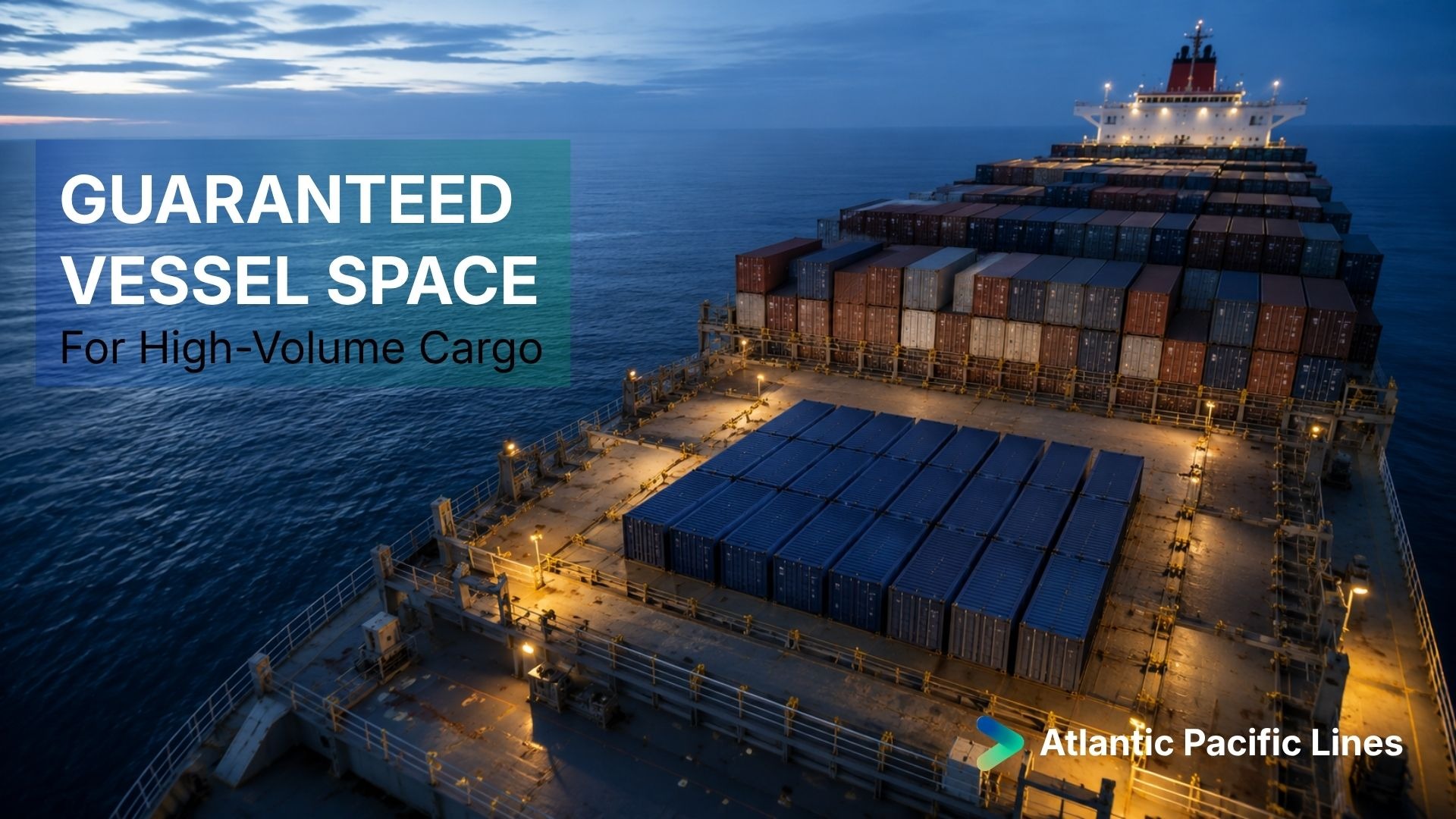
High-volume shippers secure guaranteed ocean capacity by committing space allocation with a carrier-side NVOCC rather than buying on the spot market. Allocation reserves a fixed slot count on named weekly services, backed by a contract that commits assured space for a stated volume. Atlantic Pacific Lines, an FMC-licensed NVOCC operating across more than 150 trade lanes, commits guaranteed vessel space to beneficial cargo owners and forwarder partners on the transpacific, transatlantic, and United States to India lanes.
Space is the constraint that decides whether a supply chain runs on schedule. A confirmed rate means little when there is no slot on the vessel, and the shippers who move the most volume feel that gap first. What follows is how allocation is structured, who actually controls vessel space, why volume cargo loses that space on the busiest lanes, and how a committed capacity arrangement keeps containers moving when the market tightens.
What guaranteed vessel space allocation means
Guaranteed vessel space allocation is a standing commitment of ocean capacity, agreed before a shipment is booked. Rather than requesting space for each container and waiting to learn whether it clears, a shipper with allocation holds a defined slot count on specific weekly services. The commitment is set in advance and priced against volume, which gives both sides predictability. For the shipper, a known number of containers can load each week. For the carrier or the NVOCC that holds the allocation, utilization becomes forecastable.
Allocation is not a rate. A rate fixes what a shipment costs. Allocation fixes whether the shipment moves at all. The two are usually negotiated together, but they solve different problems, and in a tight market the second problem is the one that strands cargo. This is the distinction that separates planned capacity from opportunistic booking, and it is why large importers and exporters build allocation into their routing before a season begins.
NVOCC, freight forwarder, and vessel operator: who controls the space
Three parties sit between cargo and a vessel, and only some of them can commit space.
A vessel-operating common carrier owns or operates the ships and controls the physical space on board. A non-vessel-operating common carrier, or NVOCC, does not operate ships but is still a carrier in legal terms: it contracts capacity from the vessel operators, issues its own House Bill of Lading, and takes on carrier responsibility to the shipper. A freight forwarder, by contrast, acts as an agent that arranges transport and documentation without taking on that carrier role.
The practical difference is control of space. Because an NVOCC contracts capacity directly and consolidates the volume of many shippers, it can hold committed slots and assign them to its customers. Beneficial cargo owners, the companies that own the goods on the vessel, gain from that arrangement without having to place their entire volume with a single vessel operator. Atlantic Pacific Lines is licensed by the Federal Maritime Commission as an NVOCC and operates as a freight forwarder as well, which means it can both commit space as a carrier and manage the wider forwarding and compliance work around a shipment.
How a space allocation is actually structured
A guarantee is only as good as the contract behind it. In ocean freight, that contract is usually a service contract: a reciprocal commitment in which the shipper agrees to tender a minimum volume over a set term, and the carrier commits to defined service levels in return. Under United States shipping law, those service levels can include assured space, transit time, and port rotation, which is what turns a rate agreement into a capacity commitment.
The volume side of that commitment is the minimum quantity commitment, or MQC. The shipper commits to move a stated number of containers across the term, often expressed as a weekly nomination spread evenly across the period. In exchange, the carrier plans vessel space and equipment around that volume. The commitment runs both ways: the space is reserved, and the volume is expected, so an MQC set far above real demand can leave a shipper paying for capacity it does not use. This is why a credible allocation is sized to forecast volume rather than to an optimistic target.
An NVOCC sits on both sides of this structure. It holds minimum quantity commitments with the vessel operators, and it extends committed space to its own customers under its own contracts. That two-sided position is what allows an NVOCC to confirm space on services that are effectively closed to spot cargo, and it is the basis on which Atlantic Pacific Lines books against direct service contracts with major ocean carriers across more than 150 trade lanes so that cargo holds guaranteed space even when carriers tighten capacity.
Why high-volume shippers lose space on the busiest lanes
Space disappears for reasons that have little to do with a shipper's rate. Carriers manage vessel supply actively. When demand softens they blank sailings, cancelling a scheduled departure so that cargo concentrates onto fewer ships. When demand climbs, usually ahead of major retail seasons, every service fills and the pressure runs the other way. Two mechanisms then decide which cargo actually loads.
The first is priority. When a vessel is oversubscribed, committed cargo loads before uncommitted cargo, and available space is pro-rated among contract shippers before anything is left for the spot market. A booking without a firm commitment is the first to roll, which means it is pushed to a later sailing.
The second is cost signalling. Carriers raise prices to ration scarce space through instruments such as a general rate increase, which lifts the base rate across a trade, and a peak season surcharge, which adds a charge during the busiest months. These move the price of spot space but do nothing to reserve it. Allocated cargo, priced under a contract, is insulated from both the rate volatility and the rationing. Equipment adds a third constraint underneath all of this, because a slot on the vessel is worthless without the right container in the right place, a point worth treating on its own.
Equipment is half of the guarantee
Vessel space and container equipment are booked as one thing but fail as two. A confirmed slot does not move cargo if there is no container to load, and equipment falls out of position constantly: empties pile up in discharge regions and run short at origin, reefer plugs are limited, and specialised boxes are scarce on thin lanes. A meaningful allocation therefore commits equipment alongside space, and names where and when that equipment is available.
Inland positioning is the quieter version of the same problem. Container depots and inland ramps that feed the main ports can cap how much of an allocation a shipper can actually use. A weekly commitment of more containers than a shipper's drayage and receiving capacity can turn only produces rolled bookings and storage charges. This is why allocation on equipment-sensitive lanes is planned around the depots and the inland moves, not only around the port and the sailing.
How allocation works across the major trade lanes
The principle is the same on every lane. The pressure points are not.
Transpacific, Asia to the United States and return
On the transpacific, eastbound volume from South China and the greater Shanghai region moves into the West Coast gateways of Los Angeles, Long Beach, Oakland, and the Seattle and Tacoma complex, alongside all-water services to New York and New Jersey, Savannah, and Houston. This is the highest-volume containerized lane into the United States, and it is the first to tighten when peak demand builds, particularly in the run up to the third-quarter import season. Sourcing has also broadened well beyond South China, with rising volume out of Vietnam and the wider Southeast Asian manufacturing base, which spreads the same demand across more origin ports and more services. Westbound export capacity carries a different profile, with agricultural and industrial cargo that depends on empty equipment repositioning back to origin. Full container load programs on this lane are where allocation earns its value, because a single missed sailing can push delivery out by a week or more.
Transatlantic, the United States to Europe and return
On the transatlantic, eastbound cargo from the United States and westbound cargo from the North European gateways of Rotterdam, Antwerp, Hamburg, and Bremerhaven connect to East Coast and Gulf ports including New York and New Jersey, Norfolk, Charleston, Savannah, and Houston. Capacity here is steadier than the transpacific, but it tightens around European export peaks and the schedule gaps that follow major holidays, when a run of cancelled or reduced sailings can compress several weeks of cargo into a narrow window. Allocation on this lane is less about surviving a single surge and more about holding consistent weekly space through those gaps.
The United States to India and return
On the United States to India lane, cargo routes through Nhava Sheva and Mundra on the Indian side and into East Coast, Gulf, and West Coast gateways on the United States side. Inland container depots feeding the main ports are often the real constraint, so allocation here depends as much on equipment and inland positioning as on vessel space. Transhipment adds another variable, because a share of this cargo connects through an intermediate hub rather than sailing direct, which lengthens transit and makes committed space on the connecting leg as important as space on the first. A commitment that ignores inland capacity and connections can still leave cargo waiting, which is why allocation on this lane is planned end to end rather than port to port.
Spot rate, contract rate, and guaranteed allocation compared
Volume shippers buy ocean capacity in three broad ways, and each fixes something different. The choice between buying on the spot market and committing to a contract rate is a decision in its own right, and it shapes how much space certainty a shipper can expect. Allocation sits a step beyond both, because it commits the space itself rather than only the price.
| Buying method | What it fixes | Space certainty | Best suited to |
|---|---|---|---|
| Spot booking | Price for a single shipment at the time of booking | Low. Space is subject to availability and rolls first when a vessel is full | Ad hoc or low-volume moves |
| Contract rate | Price across a defined term | Moderate. The rate is fixed, but space can still be subject to availability | Steady volume with flexible timing |
| Guaranteed allocation | A committed slot count on named weekly services | High. Space is reserved ahead of the sailing under contract | High-volume shippers that cannot absorb rollovers |
How to tell whether a space guarantee is real
Any provider can use the word guaranteed. What makes a commitment real is whether it is written down, sized correctly, and backed by the operational detail to hold. A shipper evaluating a space commitment can check for the following.
- A verifiable carrier license. Holding and issuing space as a carrier depends on the provider being a licensed common carrier, which for a United States NVOCC means an active Federal Maritime Commission license that can be confirmed on the public register.
- Named services and gateways in writing. A guarantee that names the specific services, ports, and weekly slot count is enforceable in a way that a general assurance of help is not.
- A committed volume with honest tolerance. The commitment should state the volume it covers and a realistic swing tolerance, so the space matches demand rather than an inflated forecast that leaves capacity unused.
- An equipment commitment, not only a slot. The arrangement should say what equipment is committed and where it is available, since space without a container does not move cargo.
- Defined handling of rolled bookings. Clear terms on how a rolled booking is prioritised onto the next sailing show whether the guarantee holds when a vessel fills.
- A contingency for blank sailings. A credible provider has an alternate routing plan for the weeks when a carrier cancels a service, rather than leaving the cargo to the spot market.
- Visibility and a named contact. Reporting on utilization and a specific person to call when a booking is at risk are what turn a commitment on paper into space on a vessel.
A provider that can answer all seven is committing space, not expressing intent.
How to lock allocation before the market tightens
Securing committed space is a planning exercise, not a last-minute request. A few steps make the difference.
- Forecast lane-level volume early, by service and by week, so the commitment matches real demand rather than a rough annual estimate. Contracts are set by sailing week, not by calendar year.
- Separate the volume that is steady from the volume that is not. Steady, repeatable lanes are the right place for a firm commitment, while new or seasonal volume can stay flexible until it proves out.
- Commit ahead of the season rather than during it, because allocation is set before vessels fill and the strongest positions are taken first.
- Name the services and gateways that matter to the routing, so the reserved slots sit where the cargo actually moves.
- Align equipment and inland capacity with the commitment, since a slot without the right container, or more containers than the inland network can handle, does not move cargo cleanly.
- Consolidate volume with a carrier-side partner that already holds allocation on the lane, which converts scattered bookings into committed space.
Shippers that plan capacity this way protect their schedules through peak periods. It is also the basis on which Atlantic Pacific Lines structures guaranteed allocation for the specific lanes a customer depends on, matched to forecast volume and reviewed as demand shifts.
Frequently asked questions
Secure guaranteed vessel space for your lanes
Atlantic Pacific Lines structures guaranteed vessel space allocation around the services, gateways, and equipment a shipment actually requires, sized to forecast volume and reviewed as demand shifts. Shippers moving volume on the transpacific, transatlantic, or United States to India lanes can request a quote to reserve capacity ahead of the next peak and hold committed space when the market tightens.