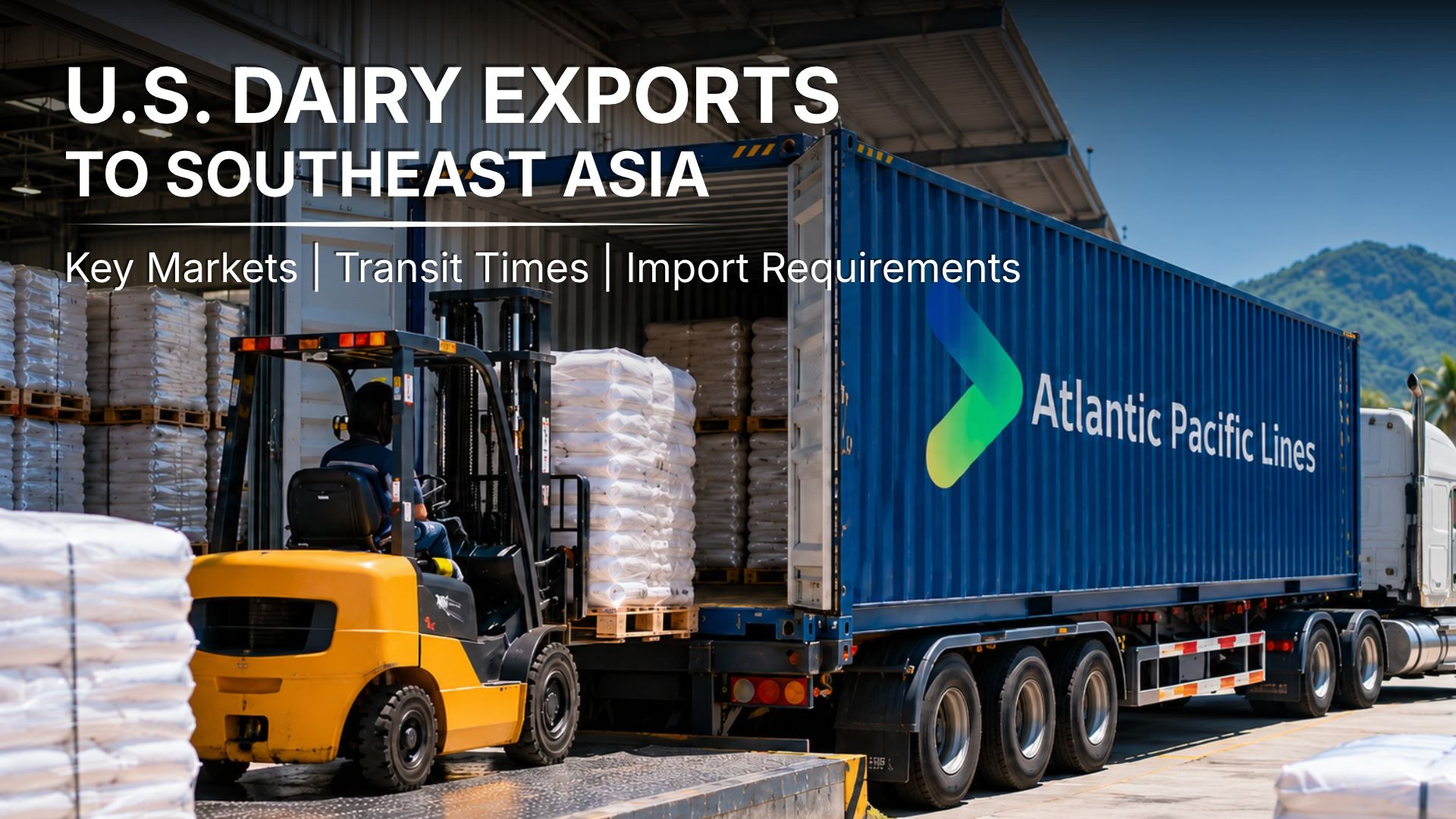
Southeast Asia is one of the largest regional markets for U.S. dairy, built mainly on skim milk powder, whey, lactose, and cheese for a region of more than 650 million people with a fast-growing food manufacturing base. Shipping into it well means knowing each market's role and rules, from Indonesia's halal registration to Malaysia's newly lowered tariffs, and planning around port-to-port transits of about 20 to 35 days from the West Coast and up to about 46 days from the East Coast. Atlantic Pacific Lines, an FMC-licensed NVOCC, books dairy exports against direct service contracts with major ocean carriers, giving exporters contracted space and priority over spot bookings, subject to space and equipment availability, and manages dry and reefer dairy from one desk.
For a U.S. dairy exporter, Southeast Asia is not one market but several, each with its own buyers, import procedures, and trade terms. The Philippines, Indonesia, and Vietnam have long been the largest U.S. dairy destinations in the region, Malaysia is its biggest dairy importer overall, and Thailand and Cambodia are opening further. This guide covers who buys what, the market access changes announced in October 2025, the halal requirement every exporter to Indonesia needs to understand, the transit times by U.S. coast, and how to plan the dry and refrigerated sides of a Southeast Asia dairy program.
Why Southeast Asia matters to U.S. dairy
The region's demand rests on three things: population, income growth, and food manufacturing. More than 650 million people live in Southeast Asia, a large share of them young, and rising urban incomes are lifting consumption of milk-based drinks, bakery goods, confectionery, and prepared foods. Domestic milk production covers only part of that demand, so the region imports heavily, and much of what it imports arrives as dried ingredients that local manufacturers recombine or blend into finished products.
The United States competes for that demand against New Zealand, the largest supplier to the region, along with the European Union and Australia. In a USDA analysis of 2018 trade, the United States held the third-largest share of the region's dairy imports, and Southeast Asia took roughly a sixth of all U.S. dairy exports. U.S. suppliers have been especially strong in skim milk powder, where the region has absorbed more than a quarter of U.S. nonfat dry milk and skim milk powder exports in some years. For a dairy exporter, that makes Southeast Asia a volume market for powders first and a growth market for cheese and higher-value ingredients second.
The markets, one by one
Each market plays a different role, and the requirements that matter differ too. The table summarizes where each country stands for U.S. dairy, using the most recent published sales figures and the market access changes announced in October 2025.
Market | Role for U.S. dairy | Access and requirements to know |
|---|---|---|
Philippines | Historically the largest Southeast Asian destination for U.S. dairy | A major buyer of skim milk powder for food manufacturing; confirm current import clearances with the importer |
Indonesia | Historically the second-largest regional destination | Halal certification registered with BPJPH applies to dairy; Indonesia's wider halal deadline for processed food took effect 17 October 2026 |
Vietnam | About $127 million of U.S. dairy in 2024 | A trade framework was announced in October 2025, with detailed terms still to be finalized |
Malaysia | About $118 million in 2024; the region's largest dairy importer overall | An October 2025 agreement removes virtually all remaining dairy tariffs and streamlines facility registration |
Thailand | About $87 million in 2024 | A trade framework was announced in October 2025, with detailed terms still to be finalized |
Cambodia | Small but growing, about $3 million in 2024 | An October 2025 agreement eliminates dairy tariffs and bars facility listing requirements for U.S. dairy |
Three points follow from the table. First, the Philippines and Indonesia remain the anchors for U.S. powder volume, so exporters building a Southeast Asia program usually start there. Second, Malaysia and Cambodia now have the clearest new access, which may shift some volume and competitive positioning toward them as the agreements take effect. Third, Vietnam and Thailand have frameworks rather than final terms, so exporters treat any expected tariff gains there as future upside rather than current pricing. In every market, the importer's confirmation of the current rules is the final word before a shipment is booked.
What sells: powders first, cheese second
U.S. dairy exports to the region are led by skim milk powder and nonfat dry milk, followed by whey products, cheese, and lactose, and together those categories make up the large majority of what the United States ships there. Powders and whey feed industrial users: makers of recombined and flavored milk, infant and adult nutrition, bakery, confectionery, and beverages. Lactose serves food and pharmaceutical manufacturing. Cheese goes largely to food service, including the quick-service and pizza chains that have expanded across the region's cities, and to retail.
That product mix shapes the logistics. Powders, whey, and lactose are shelf-stable and ship in dry containers, bagged or in totes, so most of the region's U.S. dairy volume is a dry, weight-heavy cargo rather than a refrigerated one. Cheese and butter ship in reefers at controlled temperatures, and our guide to reefer settings and the cold chain for dairy exports covers set points by product. A typical Southeast Asia program is therefore mostly dry containers with a refrigerated component, and planning the two together is part of serving the region well.
Indonesia's halal requirement
Indonesia is a large, Muslim-majority market, and halal certification is central to selling dairy there. Dairy products entering Indonesia are already subject to halal certification under the country's animal product rules, and Indonesia's broader mandatory halal requirement for processed food and beverages, including food additives and processing aids, took effect on 17 October 2026. For a U.S. dairy exporter, the practical question is not whether halal applies but whether the certificate in hand will be accepted.
Acceptance turns on two steps. The halal certificate must be issued by a certification body that BPJPH, Indonesia's halal product assurance agency, recognizes for the relevant product category, and the foreign certificate must then be registered with BPJPH before the product circulates, with the registration number appearing on the label alongside the halal mark. New registrations have historically taken months, so exporters confirm their certifier's status and the registration with the Indonesian importer well before the first shipment. Halal certification is also widely expected by buyers in the region's other Muslim-majority markets, so a recognized halal certificate is a commercial asset across Southeast Asia, not only in Indonesia.
The October 2025 trade agreements
In October 2025 the United States announced agreements with Malaysia and Cambodia and frameworks with Vietnam and Thailand that bear directly on dairy. Malaysia agreed to eliminate virtually all remaining tariffs on U.S. dairy, protect common cheese names, provide assurances on dairy certification, recognize the U.S. dairy safety system, and streamline facility registration. Cambodia agreed to eliminate all tariffs on U.S. dairy and not to maintain a facility listing requirement for U.S. dairy products. The Vietnam and Thailand frameworks outline expected gains on tariffs and non-tariff barriers, with the detailed terms to be finalized.
For exporters, these changes matter in two ways. Lower tariffs improve the landed cost of U.S. dairy against suppliers that already enjoy free trade agreements in the region, and simpler facility registration removes a common barrier for plants that have not yet been approved to ship. Because the timing and the detail of implementation can lag the announcements, exporters confirm with their importer how the terms apply on the date of shipment, and price new business on the terms in force rather than the terms expected.
Transit times by U.S. coast
Transit is the planning variable that most separates a Southeast Asia dairy program from a nearby one. The table gives typical port-to-port ranges by U.S. origin coast. Many services reach the region through a transshipment hub rather than sailing direct, so the longer end of each range is the safer basis for planning.
U.S. origin | Typical port-to-port transit | Planning note |
|---|---|---|
West Coast (Los Angeles, Long Beach, Oakland, Seattle, Tacoma) | About 20 to 35 days | Shortest routing; Vietnam sits at the faster end and the Philippines toward the longer end |
Gulf Coast (Houston) | About 30 to 46 days | Useful for Gulf and South Central origins; transshipment common |
East Coast (New York and New Jersey, Savannah, Charleston) | About 32 to 46 days | Longest routing; plan reefer cargo around the longer end of the range |
For dry powders, the transit mainly affects inventory and working capital, since a shelf-stable product tolerates a longer voyage. For cheese and butter, it affects shelf life on arrival, so refrigerated cargo usually favors the West Coast and the shortest reliable routing. Transshipment adds a handoff where a refrigerated box must stay powered and where a dry box can wait for a connecting vessel, which is why contracted space on the connecting leg matters as much as the first sailing. Our guide to the reverse direction, shipping from Vietnam and Southeast Asia to the United States, explains how hub connections shape transit on this trade.
Booked right, weighed right, and run from one desk
Two operational details decide whether a Southeast Asia dairy shipment moves cleanly. The first is the booking. Many ocean carriers leave agricultural and dairy products out of their standard general cargo rates, so a dairy booking made as ordinary general cargo can be rejected or billed differently after the fact. Atlantic Pacific Lines holds dairy commodity programs with multiple major ocean carriers, so dairy is booked under the correct commodity and billed correctly from the start, which matters on a long lane where a rejected booking costs a week or more.
The second is weight. Bagged and tote-loaded milk powder is dense and reaches legal payload limits before the container is full, so Atlantic Pacific Lines plans every load against road weight limits, rail ramp overweight thresholds, and carrier payload limits before booking, which prevents surprise overweight charges and rejected containers. For the refrigerated side, Atlantic Pacific Lines manages dry and reefer cargo from one desk and provides generator sets and temperature monitoring on its inland reefer moves, so the powder program and the cheese program to the same buyers are planned by the same team.
Building a Southeast Asia dairy program? Send Atlantic Pacific Lines your top lanes and get all-in rates back quickly.
Free time and all-in pricing on a long lane
Long lanes make dwell expensive. Free time is the period a container can stay at the terminal, or out with the shipper, without charge. Once it runs out, demurrage applies at the terminal and detention applies to the equipment, and on a five- or six-week voyage with a transshipment, an import clearance delay at destination can add charges quickly. The programs Atlantic Pacific Lines holds with its ocean carrier partners include extended free time at origin and destination, depending on the carrier and the lane, which gives cargo more room to clear. Our guide to demurrage and detention explains how the charges build.
Atlantic Pacific Lines also publishes monthly rate sheets on its regular lanes, turns around fast quotes on new lanes, and prices door to destination with inland trucking included. For a dairy exporter whose plant sits far from the gateway, an all-in rate that already contains the inland leg makes a West Coast versus East Coast decision a straight comparison rather than a spreadsheet exercise.
How contracted space protects a Southeast Asia program
Southeast Asia buyers often run dairy into continuous production lines, so a rolled container is not just late; it can leave a manufacturer short of an ingredient. Atlantic Pacific Lines books against direct service contracts with major ocean carriers across its vessel space allocation on major trade lanes, giving exporters contracted space and priority over spot bookings, so contracted cargo is protected ahead of spot cargo when space is short. When carriers cut sailings through blank sailings and withdrawn capacity, contracted space is what keeps a supply program on schedule.
Atlantic Pacific Lines handles the ocean freight, the drayage, and the transload and warehousing itself, so the move from the processing plant to the Southeast Asian port runs through one company. For the full picture of dairy shipping regimes and markets beyond this region, see our guide to shipping dairy products by ocean freight.
A planning checklist for dairy exports to Southeast Asia
Work through these steps before the first container is booked.
- Confirm the destination market's current import requirements and any facility registration with the importer, and treat announced trade terms as applying only once they are in force.
- For Indonesia, confirm that the halal certifier is recognized by BPJPH for the product and that the certificate is registered before shipment.
- Split the program into dry powders, whey, and lactose in dry containers and cheese or butter in reefers, and plan the two together.
- Choose the U.S. gateway by comparing the inland leg from the plant with the ocean transit, favoring the shortest reliable routing for refrigerated cargo.
- Plan the transit around the longer end of the range, allowing for transshipment.
- Book under the correct commodity and plan powder loads against road, rail, and carrier weight limits before booking.
- Secure contracted space ahead of the buyer's production schedule rather than relying on spot bookings.
Ready to ship dairy to Southeast Asia?
Atlantic Pacific Lines books dairy exports to Southeast Asia under the correct commodity with contracted carrier space, manages dry and reefer dairy from one desk with generator sets and temperature monitoring on inland reefer moves, and prices the move door to destination with inland trucking included. Send us your top lanes and Atlantic Pacific Lines will come back with all-in rates within 24 hours.
Frequently asked questions
Historically the Philippines has been the largest Southeast Asian destination for U.S. dairy, followed by Indonesia and Vietnam. In 2024, U.S. dairy sales reached about $127 million in Vietnam, $118 million in Malaysia, and $87 million in Thailand. Malaysia is also the largest dairy importer in the region overall, drawing supply from several exporting countries.
Skim milk powder and nonfat dry milk lead U.S. dairy exports to the region, followed by whey products, cheese, and lactose. Much of the powder and whey goes to food and beverage manufacturers that recombine milk or use dairy ingredients in their products, while cheese serves food service and retail. Powders ship in dry containers and cheese ships in refrigerated containers.
Port to port, sailings from the U.S. West Coast typically take about 20 to 35 days, with Vietnam at the faster end and the Philippines toward the longer end. From the Gulf and East Coasts, plan on about 30 to 46 days. Many services transship through a regional hub, so the longer end of the range is the safer basis for planning, especially for refrigerated cheese and butter.
Yes. Dairy products entering Indonesia are already subject to halal certification, and Indonesia's wider mandatory halal requirement for processed food and beverages took effect on 17 October 2026. A foreign halal certificate must come from a body recognized by BPJPH, Indonesia's halal authority, and be registered with BPJPH, with the registration number shown on the label. Exporters confirm the details with their Indonesian importer before shipping.
In October 2025 the United States announced agreements with both countries. Malaysia agreed to eliminate virtually all remaining tariffs on U.S. dairy, recognize the U.S. dairy safety system, and streamline facility registration. Cambodia agreed to eliminate all tariffs on U.S. dairy and not to maintain a facility listing requirement. Frameworks with Vietnam and Thailand were announced at the same time, with detailed terms still to come.
For most dairy, the West Coast gives the shortest transit, which matters most for refrigerated cheese and butter and for buyers working to tight production schedules. East and Gulf Coast routings add roughly one to two weeks but can suit plants close to those gateways. The right choice weighs the inland leg from the plant against the ocean transit and the space available on each routing.
Atlantic Pacific Lines is an FMC-licensed NVOCC that books dairy exports to Southeast Asia against direct service contracts with major ocean carriers, giving exporters contracted space and priority over spot bookings, subject to space and equipment availability. It manages dry and reefer dairy from one desk, provides generator sets and temperature monitoring on inland reefer moves, holds dairy commodity programs so cargo is booked and billed correctly, and handles the inland drayage itself.