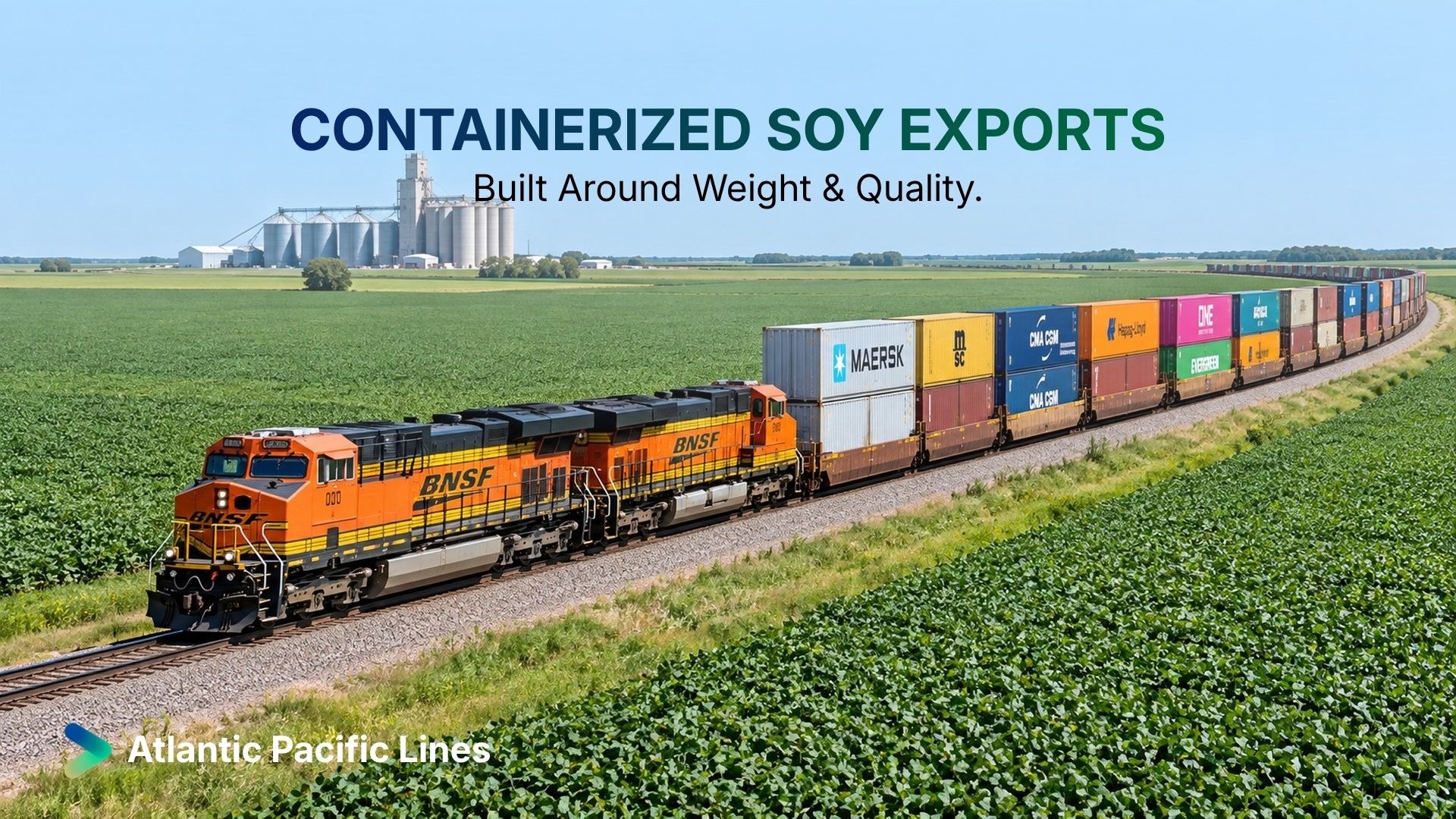
U.S. soybeans move by container when the buyer wants a specific variety, a smaller lot than a bulk ship carries, or food-grade beans kept separate from the commodity stream. About 5.1 million metric tons of U.S. soybeans shipped in containers in 2024, much of it identity-preserved food-grade soy bound for tofu, tempeh, soymilk, and natto makers in Indonesia, Taiwan, Japan, and the rest of Southeast Asia. Because soybeans hit a container's weight limit before the box is full, planning the weight is the central logistics decision. Atlantic Pacific Lines, an FMC-licensed NVOCC, plans every soybean load against road, rail ramp, and carrier weight limits before booking.
Soybeans are one of the largest U.S. agricultural exports, and most of the volume still sails in bulk from the Gulf and the Pacific Northwest. The container trade is smaller but different in kind. It serves buyers who care which farm and which variety the beans came from, processors who need a few hundred tons rather than sixty thousand, and markets where bulk handling is limited. This guide explains why soybeans moved into containers, the two very different soybean trades that share the box, where the beans go, how buyers write the quality specification, why weight decides the container size, how soybeans are loaded, and what the 2025 to 2026 market shift means for container exporters.
Why soybeans moved into containers
Containerized U.S. soybean exports grew from a niche into a large trade over the past decade, reaching about 5.1 million metric tons in 2024, alongside distillers dried grains as one of the two largest containerized agricultural commodities. Three forces drove the shift. The first is lot size: a bulk vessel to Asia often carries about 60,000 metric tons, while many soy food processors want a few containers a month. The second is quality: containers are watertight and nearly airtight, and research for the Illinois soybean industry found they help limit heat damage, insects, fungi, sprouting, and splitting over a long voyage. The third is equipment: the United States imports far more containerized goods than it exports, so empty containers are available to carry soybeans back toward Asia.
Those forces matter most to Asian buyers. Food-grade soybean orders to Japan have moved by container for decades, Taiwanese importers buy identity-preserved beans by the box directly from Midwest loading facilities, and in Indonesia container shipments have made up more than half of U.S. soybean imports. For an exporter, the container turns soybeans from a price-driven bulk commodity into a product sold on variety, quality, and reliability, which is exactly why the logistics have to protect those things.
Two soybean trades share the same box
A container of soybeans can be one of two very different products. Commodity soybeans are graded to U.S. standards and blended through the elevator system, and when they move by container it is usually for lot size or market access rather than identity. Identity-preserved soybeans are specific varieties, often food-grade and non-genetically-modified, grown under contract, stored separately, and loaded at the source so that the buyer receives exactly the beans it bought. A tofu maker in Taiwan or a natto producer in Japan is not buying soybeans; it is buying a variety with a known protein level, bean size, color, and flavor.
The difference changes how the shipment is handled from the farm onward. Commodity beans can be loaded wherever containers and beans meet, including transload facilities near the ports. IP beans need source loading, segregated storage, clean equipment, and documentation that traces the lot back to the field. Mixing the two, or loading IP beans into a container that carried something else, can turn a premium product into a rejected one. Knowing which trade a shipment belongs to is the first decision, and it shapes every decision after it.
Where containerized U.S. soybeans go
The container trade is concentrated in Asia, where soy foods are staples and processors buy in container-sized lots. The table summarizes the main destinations, what the soybeans become, and why buyers take them by container.
Destination | What the soybeans become | Why buyers take them by container |
|---|---|---|
Indonesia | Tofu and tempeh, made largely by small and mid-size producers | Container shipments have made up more than half of Indonesia's U.S. soybean imports, delivered in lots its processors can absorb |
Taiwan | Soymilk, tofu, and other soy foods | Importers order identity-preserved food-grade beans by the container straight from Midwest loading facilities |
Japan | Tofu (nearly half of food soybean demand), natto, miso, and soy beverages | Food-grade orders have moved by container for decades; Japan applies no tariff on soybean imports |
Thailand, Malaysia, Vietnam | Soy foods, beverages, and feed | Smaller lots and limited bulk infrastructure at some buyers favor the container over a 60,000-ton bulk parcel |
Bangladesh, Pakistan, Egypt | Mainly crushing and animal feed | Large and growing U.S. buyers in 2025 and 2026, mostly in bulk, with containers serving smaller and specialty lots |
The pattern is that container buyers are food buyers. Tofu accounts for nearly half of Japan's food soybean demand, Indonesia's tempeh and tofu industry is built on imported soybeans, and Taiwan's soymilk processors order by the container. Feed and crushing markets such as Egypt, Bangladesh, and Pakistan buy mostly in bulk, though containers serve their smaller and specialty lots. For an exporter deciding where to focus a container program, the food-grade markets of East and Southeast Asia are where the container's advantages are worth the most.
The quality specification buyers write into the contract
U.S. grade standards for soybeans set the baseline. Official grades limit damaged kernels, including heat-damaged kernels, foreign material, and splits, along with counts of objectionable material such as stones and glass. In 2023 USDA moved to remove soybeans of other colors as a grade-determining factor for yellow soybeans, while still allowing it to be reported when an applicant asks. For commodity soybeans, the grade and the official certificates are usually what the contract turns on.
Food-grade and IP buyers write much tighter contracts. They specify the variety, minimum protein and oil levels, bean size and uniformity, hilum color, moisture, and freedom from genetically modified material, and many ask for sustainability verification; U.S. soybeans verified under the Soybean Sustainability Assurance Protocol reached a record of more than 45 million metric tons in the 2024 to 2025 marketing year. Meeting the specification is a growing and handling job, but the logistics have to preserve it: clean containers, liners, careful loading, and documents that match the lot. Our guide to agricultural export documents covers the phytosanitary and inspection paperwork that travels with the beans.
Weight decides the container: why soybeans favor the 20-foot box
Soybeans are dense, and a container of soybeans reaches its legal weight limit long before it is full. That single fact drives the choice of equipment. Transportation researchers studying grain by container have used a practical payload of roughly 40,000 pounds for a 20-foot container and roughly 50,000 pounds for a 40-foot container. A 40-foot box offers twice the space but only about a quarter more legal weight, so for heavy beans it mostly carries empty air. That is why soybean exporters generally favor 20-foot containers, which put more of the box's capacity to work.
The binding limit is often not the container's own rating but the road. The truck move between the elevator and the rail ramp or port is governed by state road weight rules, and the rail ramp may apply its own overweight threshold. A soybean container that is legal for the ocean can still be too heavy for the road leg, which can mean a rejected box, a reload, or an overweight charge discovered hundreds of miles from the port. The shipper must also declare an accurate verified gross mass under SOLAS before the container is loaded on the vessel.
This is where Atlantic Pacific Lines does its most important work on a soybean program. Before a soybean container is booked, Atlantic Pacific Lines works out the tons per box against three ceilings: the state road limit on the drayage leg from the elevator, the overweight threshold at the rail ramp, and the ocean carrier's payload limit. Container size, chassis, and load per box are then fixed at the stage when changing them costs nothing. On a dense commodity sold in container lots, getting the tons per box right does more for the landed cost than almost any other single decision, because it sets how many containers the contract needs.
Exporting food-grade or commodity soybeans by container? Send Atlantic Pacific Lines your origins and target markets for a load plan and all-in rates.
Loading soybeans: liners, bulkheads, bags, and totes
Most containerized soybeans are loaded in bulk. The container is fitted with a bulkhead at the door to hold the load and is usually lined with a plastic liner, sometimes called a bladder, which keeps the beans off the container walls and floor and meets food and grain cleanliness standards. Bulk loading equipment then fills the lined container through the door opening. Some buyers prefer bags or large totes instead, particularly for small specialty lots or where the receiving plant handles bagged product, and the container is then loaded as packaged cargo with dunnage and securing.
The loading point matters as much as the method. Facilities in the Chicago area and elsewhere in the Midwest have converted from bulk to container load-out to take advantage of nearby empty containers, while IP shippers in Ohio, Kentucky, Minnesota, North Dakota, and Missouri load at their own facilities to keep varieties segregated. Exporters in inland locations with few empty containers, such as some parts of the Upper Midwest and the Plains, face tighter equipment availability. Moisture protection is a separate question covered in our guide to preventing container rain and cargo sweat.
Protecting identity from the field to the tofu plant
Identity preservation is a chain, and the container is one link in it. The beans are grown from specified seed, harvested and stored separately, cleaned and graded, and loaded at the source into a container that has been inspected for cleanliness and odor. The container is sealed, and the seal number, the lot, and the variety are carried through the documents so the buyer can trace what arrives back to what was loaded. Any break in that chain, a shared storage bin, a dirty container, or a mismatch between the lot and the paperwork, can cost the premium the buyer paid.
For exporters, the practical discipline is keeping the IP lot intact through every handoff. That means booking far enough ahead that a clean container arrives at the loading facility when the beans are ready, avoiding transload steps that would mix lots, and making sure the bill of lading, the inspection certificates, and the buyer's contract all describe the same lot. Atlantic Pacific Lines books the cargo under the correct commodity with the ocean carrier and issues the bill of lading as the NVOCC, which keeps the lot description consistent from the loading facility to the buyer.
Reading the 2025 to 2026 soybean market shift
The soybean export map changed in 2025 and 2026. China, long the largest buyer of U.S. soybeans, suspended purchases for several months in 2025 and, as of July 2026, had cut its commitments for the 2025 to 2026 marketing year by about 45 percent from a year earlier. Other markets grew: Indonesia rose about 20 percent after a July 2025 trade deal, Japan about 10 percent after an October 2025 purchase commitment, Bangladesh about 49 percent, Egypt about 42 percent, and Pakistan more than fourfold after lifting a ban on genetically modified crop imports. Our guide to export capacity on the United States to China lane covers the westbound transpacific in general.
Most of those headline volumes move in bulk, but the shift matters to container exporters in two ways. It increases the relative importance of the food-grade markets of Southeast Asia and Japan, where the container is the natural format, and it raises competition for equipment and space on the lanes serving them. Exporters who planned around a China-heavy market are now selling more beans into Indonesia, Taiwan, Japan, and their neighbors, which makes reliable container space on those lanes worth securing before the harvest rush.
Working with Atlantic Pacific Lines on a soybean program
Atlantic Pacific Lines books against direct service contracts with major ocean carriers, giving exporters contracted space and priority over spot bookings. On soybeans that matters most in the weeks after harvest, when food-grade buyers in Asia want their contracted volume and spot space on the westbound lanes thins out; our guide to how contracted allocation works across trade lanes explains the mechanics. Soybeans are filed with the carrier under agricultural commodity programs so the invoice matches the quote, Atlantic Pacific Lines' programs with its ocean carrier partners include extended free time at origin and destination, depending on carrier and lane, and full-container ocean freight is quoted as one price from the loading facility to the destination port.
Ready to ship soybeans by container?
Tell Atlantic Pacific Lines where your beans load, whether they are commodity or identity-preserved, and which markets you sell into. Send us your top lanes and Atlantic Pacific Lines will come back with a load plan and all-in rates within 24 hours.
Frequently asked questions
Containers let buyers purchase in smaller lots, keep identity-preserved food-grade soybeans segregated from the commodity stream, and reach importers without bulk terminals. A bulk vessel to Asia often carries about 60,000 metric tons, far more than a tofu or soymilk maker needs. Containers are also watertight and nearly airtight, which helps limit heat damage, insects, and splitting on the long voyage from the Midwest.
The limit is weight, not space. Soybeans reach the legal payload of a container before the box is full, and the binding figure is often the road weight rule on the inland drayage leg rather than the container's own rating. Researchers have used a payload of roughly 40,000 pounds for a 20-foot container and 50,000 pounds for a 40-foot container, which is why heavy soybean loads favor the 20-foot box.
Identity-preserved, or IP, soybeans are varieties grown, handled, and shipped separately from commodity soybeans so the buyer receives a specific variety with known traits, such as a food-grade, non-genetically-modified bean for tofu or soymilk. Keeping the identity intact means segregated storage and loading at the source, which is why IP soybeans move almost entirely by container from origin loading facilities.
Indonesia, Taiwan, Japan, Thailand, Malaysia, and Vietnam are the leading container markets, driven by tofu, tempeh, soymilk, natto, and other soy foods. Indonesia stands out: container shipments have made up more than half of its U.S. soybean imports. Containerized U.S. soybean exports reached about 5.1 million metric tons in 2024.
U.S. grade standards for soybeans set limits on damaged kernels, including heat damage, foreign material, and splits. Food-grade and IP contracts usually go further, specifying variety, protein and oil content, bean size, and freedom from genetically modified material. USDA moved in 2023 to remove soybeans of other colors as a grade-determining factor for yellow soybeans, though it can still be reported on request.
China cut its U.S. soybean commitments sharply, down about 45 percent year over year for the 2025 to 2026 marketing year as of July 2026. Other buyers grew, including Indonesia, Japan, Bangladesh, Egypt, and Pakistan, which lifted a ban on genetically modified crop imports. For container exporters the shift raised the weight of Southeast Asian and Japanese food-grade markets.
Atlantic Pacific Lines is an FMC-licensed NVOCC that books containerized soybean exports against direct service contracts with major ocean carriers, giving exporters contracted space and priority over spot bookings, subject to space and equipment availability. It plans each soybean load against road, rail ramp, and carrier weight limits before booking, so the right container size and load per box are settled before the beans are loaded.