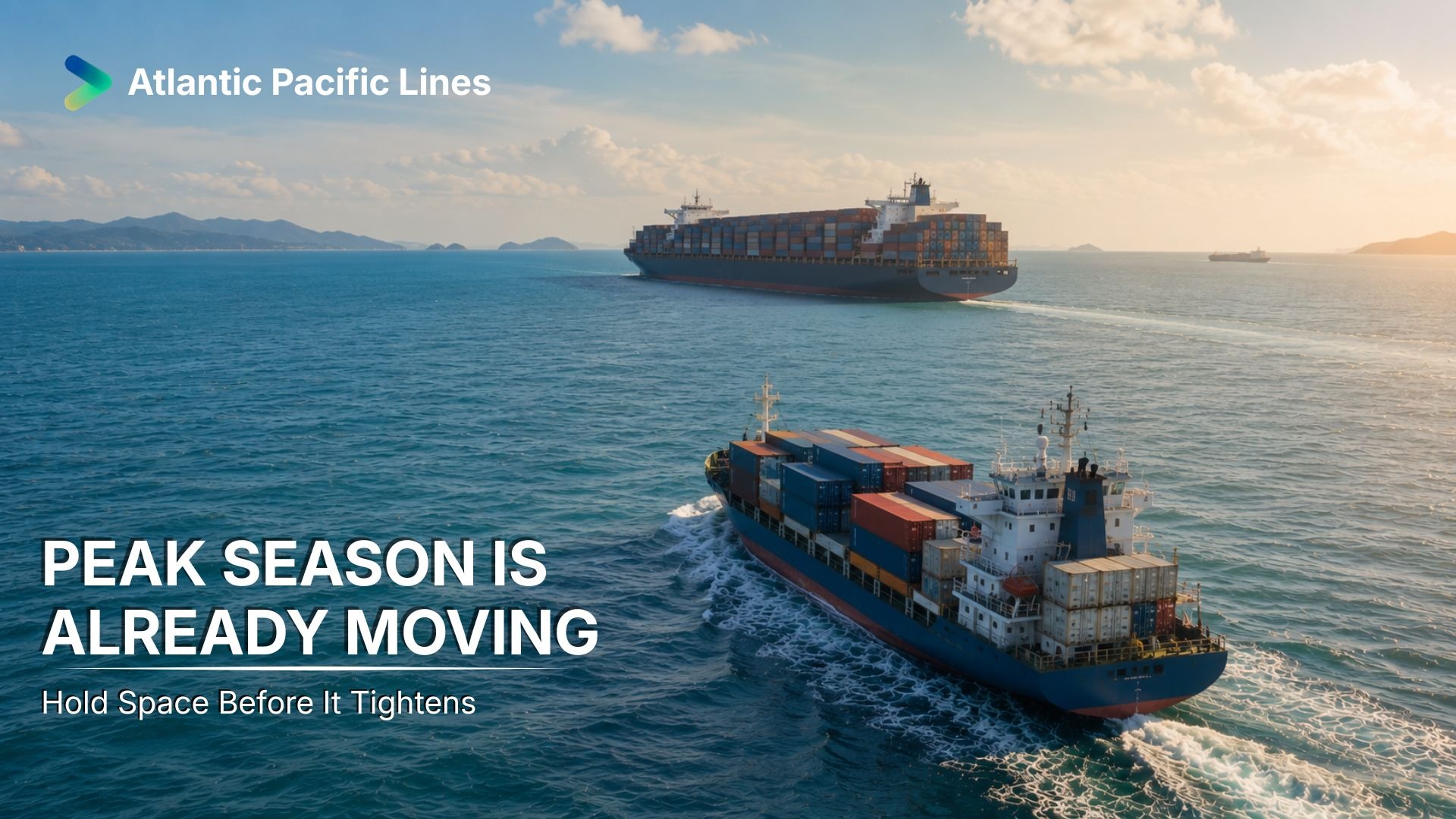
The 2026 peak season arrived early, and it is running on unusual mechanics: demand that was pulled forward by a tariff deadline, a duty regime that changed permanently in late July, and carriers withdrawing capacity into the peak rather than adding it. Space through late summer belongs to shippers holding guaranteed vessel space allocation, because committed cargo loads first when sailings are cut. Atlantic Pacific Lines, an FMC-licensed NVOCC, commits allocation across the transpacific, India, and transatlantic lanes through the peak.
Every peak season has a shape, and reading the shape early is most of the game. The 2026 shape is stranger than usual. This outlook walks through the four forces defining it, where each of the major lanes tightens first, and what the shippers who will move cleanly through August and September are doing differently. The directional picture is here. The month's numbers behind it, rate levels, the withdrawal schedule week by week, and origin-by-origin space outlooks, live in Ocean Pulse, the monthly market brief from Atlantic Pacific Lines, and this outlook will point there rather than reproduce them.
A peak that arrived early and then changed its reason
The 2026 import peak did not build on the usual retail calendar. Through the first half of the year, United States imports from Asia ran hot because shippers were racing a tariff deadline, pulling forward cargo that would otherwise have moved in the traditional third-quarter window. Demand crested in late spring at levels the trade had not seen since the previous summer, then began to flatten as the pull-forward exhausted itself. A peak borrowed from the future leaves a quieter autumn behind it, and forecasters who raised their early-summer outlooks have trimmed the back half of the year.
For capacity planning, an early peak is a trap. The shipper who assumes the traditional calendar still applies is committing space for a surge that has partly already happened, while standing uncommitted in the weeks where the real squeeze has moved: the late-summer window where flattening demand meets deliberately withdrawn supply.
The duty regime reset the calendar in late July
The deadline that shaped the first half of the year is gone. On July 24, the temporary import surcharge that had driven the front-loading reached its statutory limit and lapsed, and it was replaced in the same moment by a new set of duties under Section 301 that carry no expiration date, applied at one of two rates depending on origin and covering nearly all United States imports. The strategic consequence is larger than the rate itself: there is no longer a date to beat. Shipping earlier no longer avoids anything, which removes the artificial urgency from the demand side and returns planning to the question that actually decides outcomes in the second half of 2026, which is capacity.
The new regime does reshape sourcing math, because origins landed in different duty tiers and the gap between tiers changes landed cost comparisons across Asia. Which origin sits in which tier, and what that does to cost per lane, is exactly the kind of detail this outlook leaves to the August edition of Ocean Pulse, which maps the tiers against the lanes Atlantic Pacific Lines serves and sets out the entry filing changes importers need from their brokers. The planning point for this outlook is simpler: duty certainty has returned, capacity certainty has not.
Carriers are withdrawing capacity into the peak
The defining supply-side fact of this peak is that carriers are cutting sailings into it. With West Coast spot pricing softening through July, carriers answered with a general rate increase from the first of August and an unusually heavy blank sailing program running through late August, concentrated most heavily on the Pacific Southwest gateways and touching every coast. Withdrawn sailings do not remove demand. They bunch it, onto fewer vessels and into uneven arrival patterns that United States terminals and inland ramps then have to digest.
Structural withdrawals are compounding the weekly cuts. The India to United States East Coast trade, which lost a long-running direct service in June, lost a second service as August opened, an event covered in our guide to guaranteed vessel space between the United States and India, and space on that lane is effectively spoken for weeks ahead, with the first genuine relief signal tied to a withdrawn service expected back later in August. And unlike the last demand spike, there is little spare tonnage to ride to the rescue: rates are firming on the other major East-West and North-South trades at the same time, which caps what carriers can redeploy into the transpacific and slows any correction.
Lane by lane: where space tightens first
On the transpacific, tightness is arriving origin by origin rather than as one wall. Taiwan is running the tightest of the major origins, with rolling reported broadly. Several of the main China origin groups are tight to specific coasts rather than uniformly, which rewards shippers who can shift gateways. Southeast Asian origins are tight through mid-August with carrier forecasts signalling relief from the second half of the month, while the region's main transhipment hub stays tight with no easing indicated, a distinction that matters enormously for cargo that connects rather than sails direct. The seasonal mechanics of the lane, and why committed cargo loads first through exactly these weeks, are covered in our guide to guaranteed vessel space from China to the United States in peak season.
On the India lane, the story is subtraction: two services out, premium pricing on much of what remains, and relief dependent on a single service returning. On the transatlantic, the pressure is calendar-driven rather than structural, with the rush ahead of Europe's August factory shutdowns compressing westbound sailings exactly as described in our guide to guaranteed vessel space from the United States to Europe, which covers the gap dynamics from the export side. Different lanes, one common thread: in every case the squeeze lands first on uncommitted bookings, because that is how space is rationed when vessels fill.
Equipment will outlast the space crunch
The quieter forecast in this outlook is about boxes, not slots. Container equipment is short at a string of major Asian origins and across the inland depots of North India, with shortages concentrated in the standard dry sizes that most cargo ships in, and weight restrictions appearing on selected strings. Space constraints ease when blank sailing programs end and withdrawn services return. Equipment imbalances take longer to unwind, because they are corrected one repositioning voyage at a time. Shippers should expect the equipment constraint to outlast the space constraint this season, and a commitment that reserves a slot without naming the container, the depot, and the week is only half a commitment.
How to hold allocation through this peak
The shippers who will move cleanly through the next eight weeks share a short list of habits.
- Re-baseline the plan against the new calendar, since the pull-forward is over and the squeeze has moved to the late-summer window where withdrawn capacity meets bunched demand.
- Commit allocation across services and gateways rather than pinning volume to one loop, because a heavy blank sailing program is precisely when single-service exposure fails.
- Commit equipment with the space, named by depot and week, on the origins where boxes are short.
- Pre-book constrained lanes weeks ahead, India to the United States East Coast above all, rather than testing the spot market on lanes that are already spoken for.
- Plan origin cutoffs around the August holiday calendar across Asia, which removes working days exactly when the withdrawal program is heaviest.
- Watch the relief signals before committing to them, including whether the August rate increase holds, whether Southeast Asia eases on schedule, and whether the withdrawn India service returns as expected.
Committed allocation is the instrument behind every one of those habits. It is the basis on which Atlantic Pacific Lines structures guaranteed space through the peak for beneficial cargo owners and forwarder partners on the lanes this outlook covers.
Where the full picture lives
This outlook is deliberately directional. The numbers that sit behind it, the current and announced rate levels by gateway, the blank sailing schedule week by week with the TEU withdrawn, the origin-by-origin space outlook through early autumn, the equipment shortage list by port, the August holiday calendar, and the four recommended customer actions, are published monthly in Ocean Pulse, the market intelligence brief from Atlantic Pacific Lines. The August edition covers the new duty regime, the capacity withdrawal, and the constrained origins in the detail a planning decision deserves. This page tells you the direction of the market. The brief tells you the numbers.