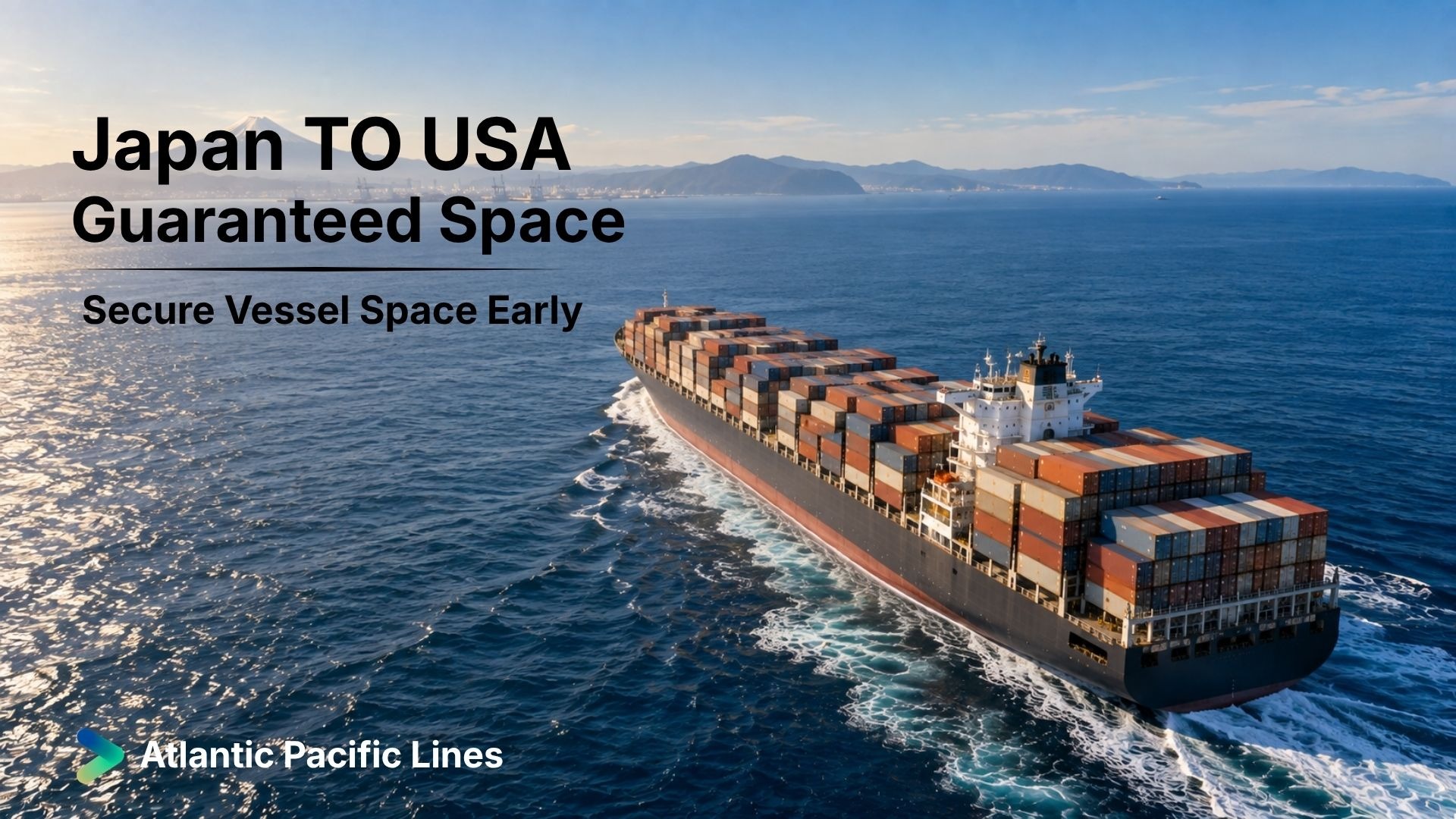
Shippers secure vessel space from Japan to the United States by committing allocation on the frequent Kanto-region services early, because much of the lane's high-value, schedule-sensitive cargo cannot absorb a rolled sailing and much of its capacity is shared with the wider transpacific. Direct services from Yokohama and Tokyo reach the United States West Coast in roughly 12 to 18 days port to port, with the fastest direct sailings at the lower end, and the East Coast in commonly around 28 to 38 days or more via the Panama Canal. Atlantic Pacific Lines, an FMC-licensed NVOCC, uses committed vessel space allocation and multi-service planning to improve capacity certainty from the Japanese gateways to the United States.
Japan is a precision manufacturing economy, and its container trade to the United States carries the character of one: high-value, tightly scheduled cargo where the cost of a delay is measured against a production line or a product launch rather than against the freight rate. Automotive components, machinery, industrial and electronic equipment, specialty chemicals and materials, and a steady base of consumer goods move on this lane, much of it feeding American factories on just-in-time schedules that leave little room for a missed sailing. This guide covers what actually moves on the Japan to United States lane and why its profile raises the stakes on space, the Japanese gateways led by the Kanto ports, the verified transit expectations by coast, the just-in-time discipline the lane demands, how it shares capacity with the wider transpacific, and how committed allocation holds it through the contested weeks.
What moves on the Japan to United States lane
Japan's containerized exports to the United States concentrate in high-value, engineering-intensive categories. Automotive components are among the most important, feeding both Japanese-owned assembly plants in the United States and the wider American automotive supply chain, and much of this cargo runs to just-in-time schedules where a late shipment threatens line continuity rather than shelf availability. Machinery and industrial equipment, precision instruments, electronics and electronic components, specialty chemicals and advanced materials, tires, and a consistent base of consumer and packaged goods fill the rest of the trade. The common thread is value density and schedule sensitivity: the containers carry cargo whose late arrival costs far more than the freight, which changes the calculus on how it should be booked.
As on the other North Asian lanes, it is worth being clear about what does not move in containers, because it defines what an NVOCC actually handles. Finished vehicles, for which Japan is a major exporter, move predominantly on specialized roll-on roll-off car carriers rather than in containers, and so sit outside this lane. What the container trade carries is the parts, the components, the machinery, the materials, and the finished consumer goods, and that cargo shares the property that runs through the whole trade: it is precise, scheduled, and intolerant of delay, so capacity certainty is worth more on it than a marginal rate saving.
The gateways: the Kanto ports and the western alternatives
Japan ships to the United States through a well-developed set of gateways, led by the Kanto region ports serving greater Tokyo. Yokohama is Japan's busiest container gateway and offers the most frequent direct services and the deepest choice to the United States West Coast, with Tokyo alongside it serving the same metropolitan manufacturing base. Together the Kanto ports carry the largest share of the lane. To the west, Kobe and Osaka serve the Kansai region and western Japan, sometimes on slightly longer routings, while Nagoya anchors the central Chubu region, the heart of Japan's automotive and machinery industry, feeding parts and components onto the lane. The density and frequency of these services, especially from the Kanto ports, is one of the lane's real advantages, giving shippers more sailings to plan around than thinner origins offer.
| Gateway | Serves | Role on the United States lane |
|---|---|---|
| Yokohama | The greater Tokyo and Kanto industrial region | Japan's busiest container gateway, with the most frequent direct services and the deepest choice to the United States West Coast |
| Tokyo | The Tokyo metropolitan manufacturing base | A major gateway alongside Yokohama for the Kanto region, on frequent direct transpacific services |
| Kobe and Osaka | The Kansai region and western Japan | The western gateways, serving Osaka-Kobe industry, sometimes on slightly longer routings than the Kanto ports |
| Nagoya | The central Chubu automotive and machinery cluster | The gateway for central Japan's automotive and industrial heartland, feeding parts and components to the lane |
Transit times from Japan to the United States
Japan sits favorably on the transpacific, and its direct services are among the fastest container routes between Asia and the United States. Yokohama and Tokyo to the United States West Coast, landing at Los Angeles and Long Beach, Oakland, or the Pacific Northwest, run roughly 12 to 18 days port to port, with the fastest direct sailings near the lower end of that range and the Kanto ports often making an early call before the Pacific crossing. All-water services to the United States East Coast, transiting the Panama Canal to New York and New Jersey, Savannah, Norfolk, and Charleston, run substantially longer, commonly around 28 to 38 days or more. Routings from the western gateways or those that connect over another hub add time.
The planning discipline is the one that governs every lane in this cluster: these are healthy-conditions figures, and the honest plan works to the longer end of each range. Less than container load shipments add several days for consolidation and deconsolidation, peak-season congestion and blank sailings lengthen transit, and the East Coast routing carries the added variable of Panama Canal conditions, which have varied and can stretch schedules when they tighten. On cargo feeding a production line, the conservative end of the range is the number to plan against, because the cost of arriving late is not counted in storage days but in the operations the cargo was meant to keep running.
Just-in-time is the lane's defining discipline
More than most trades, the Japan to United States lane is shaped by just-in-time logistics, the manufacturing philosophy Japanese industry pioneered and still runs on. Just-in-time deliberately minimizes inventory, holding as little stock as possible and relying on components arriving exactly when needed. It is efficient precisely because it removes the buffer, and that is also what makes it fragile: with little inventory standing between a delayed shipment and a stopped line, a rolled sailing on a critical component is not an inconvenience but an operational threat. On this lane, the cargo most exposed to that fragility is exactly the cargo that moves most, automotive and machinery components feeding scheduled production.
The consequence for capacity planning is direct. For just-in-time cargo, committed vessel space is not a cost-optimization measure but a continuity measure, closer to how a manufacturer treats a critical supplier than to how a shipper treats a freight rate. The shippers who move this cargo well secure space in advance and hold it across more than one service, so that a single blank sailing or a missed connection has an alternative rather than becoming a line-down event. The honest framing throughout is that committed allocation improves the certainty of loading materially without eliminating every operational risk, which is exactly why it is planned across services and built with buffer rather than treated as a guarantee against all disruption.
How Japan shares capacity with the wider transpacific
Japan is a mature, mid-size origin on the transpacific, and while its service frequency is strong, much of its capacity rides vessel strings shared with the broader Asia trade. That sharing means Japanese cargo is exposed to capacity decisions made around the wider market rather than Japanese demand alone. When the transpacific tightens into a peak, or when carriers run the capacity programs that follow the major Chinese holidays, Japanese space can tighten alongside it, and the sailings removed in a blank sailing program may be the very ones Japanese cargo was booked on. The mechanics of that shared-network tightness, and why committed cargo holds through it, are covered from the China side in our guide to guaranteed vessel space from China to the United States in peak season.
The practical lesson mirrors the one on the other North Asian origins. Japan's strong service frequency softens the effect, giving shippers more alternatives than a thin origin has, but it does not remove the exposure, and a program that assumes Japanese demand governs Japanese space will be surprised in a broad transpacific squeeze. Japanese shippers should review their services for shared-string exposure to region-wide capacity moves, and treat the lane's real frequency as a reason to spread allocation across services rather than as a reason to assume space will always be there.
Natural disruption: the resilience the lane is built around
Japan's geography adds a category of risk that few other origins carry to the same degree, and planning for it is part of shipping the lane well. Japan sits in one of the most seismically and meteorologically active regions in the world, exposed to earthquakes, tsunamis, and a typhoon season that runs through the late summer and autumn. A major event can close ports, halt terminal operations, disrupt the inland road and rail network that feeds the gateways, and, most consequentially for the supply chain, damage or idle the factories that produce the cargo. The lane has seen this repeatedly, and Japanese industry has responded by building resilience into its logistics in ways that shape how the trade behaves.
For a shipper, the practical implications are twofold. First, the schedule recovery after a disruption follows the familiar pattern, ports and services that lose days recover them by omitting calls and cutting sailings, so a natural event becomes a capacity event that outlasts the weather or the tremor by weeks. Second, and specific to Japan, the just-in-time systems that make the lane efficient are also what make a supply shock propagate fast, because there is little inventory to absorb a production interruption at origin. The response that experienced shippers adopt is not to predict the unpredictable but to build resilience the way Japanese manufacturers themselves do: buffer in the schedule during the higher-risk months, allocation held across more than one service and gateway so a single closed port is not the whole program, and a plan that assumes recovery will take longer than the event itself. None of this eliminates the risk, but it converts a disruption from a crisis into a managed contingency.
Consumer and specialty goods: the quieter half of the trade
Alongside the industrial cargo runs a substantial and growing base of Japanese consumer and specialty goods bound for the United States, and it has its own capacity character worth understanding. Packaged foods and beverages, cosmetics and personal care products, household and lifestyle goods, and a wide range of branded specialty items move on the lane in steady volume, and much of this cargo is tied to retail calendars, seasonal releases, and product launches that give it hard dates of its own. A cosmetics line timed to a seasonal reset or a specialty food arriving for a promotional window cannot simply wait for the next open sailing without commercial consequence.
Some of this cargo also carries handling requirements that shape the booking. Temperature-sensitive food and beverage products may need refrigerated or protected transport, which draws on a narrower equipment pool that must be committed separately from the dry space, and quality-sensitive goods reward careful transit planning to avoid the delays and rehandling that consolidation can add. The point that unites the industrial and the consumer halves of the trade is the same one that runs through the whole lane: this is high-value, schedule-sensitive cargo where the arrival date carries real commercial weight, and the shippers who move it best treat vessel space as something to secure in advance rather than to source at the last minute.
The West Coast and East Coast decision for Japanese cargo
Japanese importers face the transpacific's routing choice with the same logic that governs the wider trade. West Coast arrival in roughly 12 to 18 days, followed by transloading or intermodal rail inland, is the speed play, and for just-in-time components feeding western or centrally-distributed production it is usually right, because the earliest arrival protects the line. All-water East Coast routings, commonly 28 to 38 days or more, suit cargo whose destination sits in the eastern half of the country and whose schedule can absorb the longer crossing in exchange for skipping a transcontinental inland move. The deciding question is delivered time and cost to the final door, not which coast the vessel reaches first, and for a lane carrying this much schedule-critical cargo, the routing decision is part of the capacity plan rather than separate from it.
Documentation and the deadlines that decide loading
On a lane carrying this much schedule-critical cargo, the booking is only as reliable as the paperwork behind it, and the deadlines bind hardest in exactly the busy weeks. For ocean shipments to the United States, an Importer Security Filing must be filed with United States Customs before the cargo is loaded onto the vessel in Japan, generally at least twenty-four hours before loading, and a late or missing filing can bring penalties and holds regardless of how much space the vessel had. Each container also needs its verified gross mass documented before it loads, and the cargo has to meet the gateway's documentation and gate cutoffs ahead of the sailing. A container that misses any of these does not simply wait politely; it can be left behind while its committed space sails without it, which on just-in-time cargo is the worst possible outcome.
The discipline that prevents it is unglamorous and reliable: build every booking backward from the cutoffs, file documentation and the security filing early rather than at the deadline, and treat the paperwork as part of the shipment rather than an afterthought to it. On the arrival side, accurate classification and a clean customs entry keep a fast ocean crossing from stalling at the destination, and clearing customs before the vessel arrives keeps cargo from sitting at the terminal accruing charges. For high-value Japanese cargo, where the container's contents are worth far more than the freight, the cost of a documentation failure is measured against the cargo and the schedule it serves, which is why experienced shippers on this lane run the paperwork with the same precision the manufacturing behind it demands.
How committed allocation is structured on this lane
Atlantic Pacific Lines books against direct service contracts with major ocean carriers and uses committed allocation and multi-service planning on supported Japanese services to improve capacity certainty through the lane's contested weeks, with equipment planned inside the commitment and full container load programs built around each shipper's gateways and cargo profile. On a lane where just-in-time cargo dominates and capacity is shared with the wider transpacific, the multi-service element does most of the work: allocation spread across loops keeps a program moving when a single shared string fills or blanks, subject as always to carrier capacity, equipment, and the applicable service agreement. On the arrival side, bunched peak arrivals into the West Coast gateways tighten drayage and terminal appointments, so the plan runs through delivery rather than stopping at the port. The honest pitch on this lane is not that disruption can be eliminated, but that on cargo this schedule-critical, holding a committed claim across more than one service is worth disproportionately more than the rate saving of an uncommitted booking.
How to lock Japan to United States space
A short list of disciplines fits this lane's specific shape.
- Weigh the cost of a missed sailing against the freight rate honestly, since on just-in-time components and high-value cargo the delay cost usually dominates the rate comparison outright.
- Commit allocation early and across more than one service, using the Kanto region's strong frequency to spread the commitment rather than to justify leaving space uncommitted.
- Review services for shared-string exposure to region-wide capacity moves, including the blank sailing programs that follow the major Chinese holidays, which Japan does not observe but whose sailings it can share.
- Choose the coast by delivered time and cost to the final door, treating the West Coast or East Coast routing as part of the capacity plan for schedule-critical cargo.
- Commit equipment alongside the space for peak loadings, so the container is as certain as the slot.
- Plan the United States arrival side, aligning drayage and delivery to the actual arrival window so bunched peak arrivals do not undo the ocean plan.
Programs built this way treat the lane's shared-network exposure and its just-in-time demands as known properties rather than recurring surprises. It is the basis on which Atlantic Pacific Lines structures committed space from Japan to the United States, matched to each shipper's gateways, cargo, and calendars.