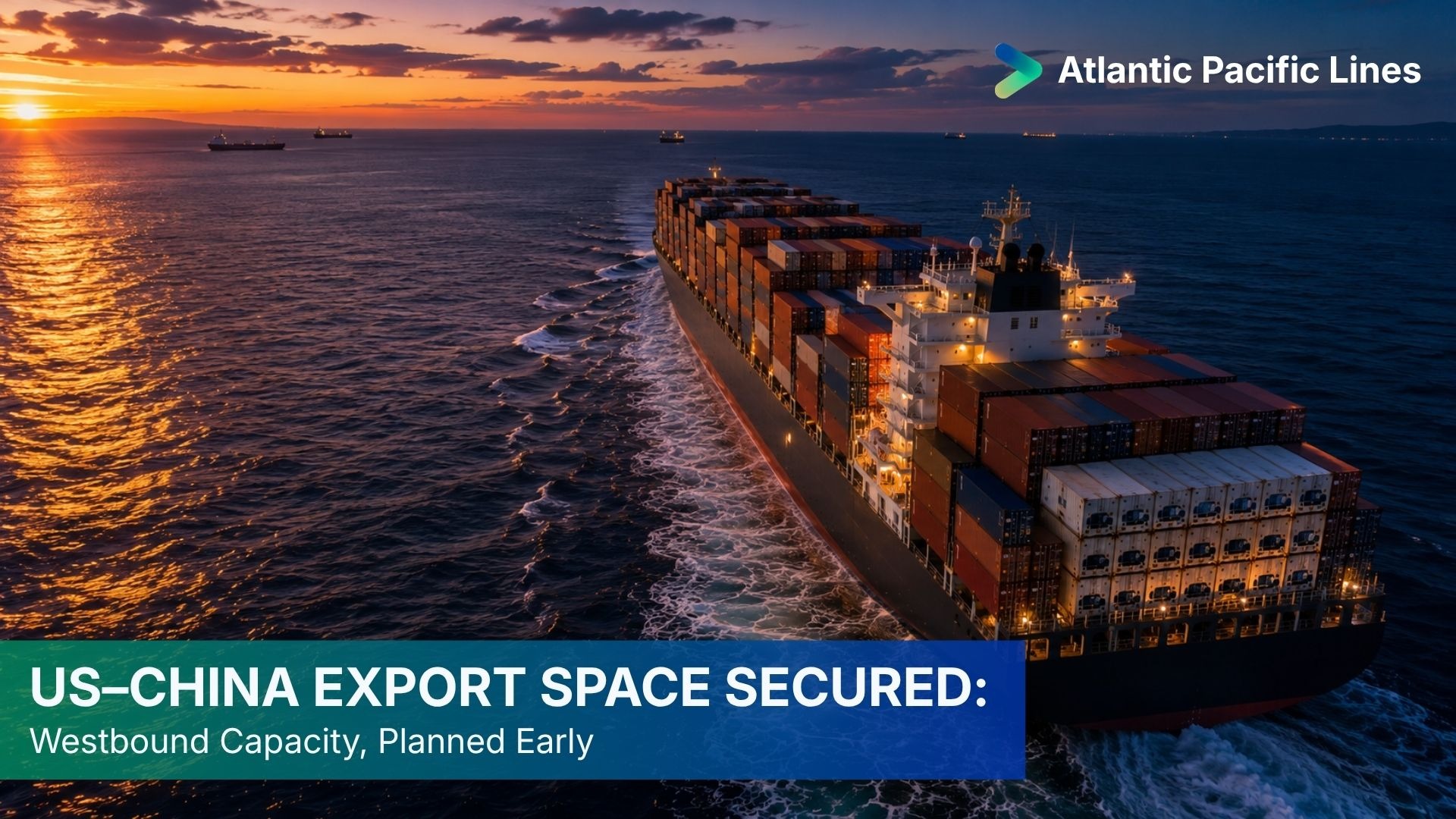
United States exporters secure guaranteed vessel space to China by committing westbound allocation with the container equipment positioned at the inland loading point, because on this lane a laden export competes with the carrier's own empty repositioning for the same slot. Committed export cargo loads ahead of uncommitted bookings when westbound space tightens. Atlantic Pacific Lines, an FMC-licensed NVOCC, commits guaranteed vessel space, booking, and shipping capacity from the United States to China for agricultural, refrigerated and industrial exporters.
The westbound transpacific runs on a logic that surprises exporters who learned the trade on the import side. Space to China is not scarcest when export demand peaks. It is often scarcest when import demand peaks, for reasons that have everything to do with what carriers want to do with their empty containers. This guide covers how the export lane is structured, why westbound space vanishes when the eastbound market booms, what that means for equipment at inland loading points, and how committed allocation keeps United States to China cargo moving through it.
How the United States to China export lane is structured
Westbound cargo to China concentrates on the West Coast gateways: Los Angeles and Long Beach, Oakland, and the Seattle and Tacoma complex, with weekly sailings to the main China ports. Oakland and the Pacific Northwest carry a heavy share of the agricultural trade, drawing on the interior by rail, while all-water services from Gulf and East Coast ports carry cargo that originates closer to those coasts. The export base itself is broad: agricultural dry cargo including soybeans, grains, cotton, and forage, refrigerated proteins and produce, chemicals, out of the Gulf, and machinery.
The shape of a transpacific rotation explains why the gateways play the roles they do. Vessels arriving from Asia discharge the bulk of their import cargo at the first calls, typically the Southern California complex, and work up or across the coast loading exports before turning back. Oakland often sits toward the end of that rotation, which is exactly where an export port wants to be, since a late call means the vessel arrives with its import cargo already discharged and its space open for loading. The Pacific Northwest plays a parallel role for cargo railed from the Midwest, sitting closest to the great circle route back to Asia. Exporters who understand where their gateway sits in the rotation understand something about their space: a booking at a late-rotation export call is competing with empties for room the vessel has already made, not with import cargo still on board.
| Export cargo group | Typical gateways | Space and equipment considerations |
|---|---|---|
| Agricultural dry cargo | Oakland, Seattle and Tacoma, Los Angeles and Long Beach | Loads inland or transloads at the coast, peaks with the autumn harvest, and depends on empty containers reaching interior points |
| Refrigerated proteins and produce | Oakland, Los Angeles and Long Beach, Pacific Northwest | Draws on a smaller reefer equipment pool with limited vessel plugs, so reefer space is committed separately from dry |
| Machinery and industrial cargo | West Coast and all-water East Coast gateways | Moves against project timelines, where a rolled booking can hold up an installation rather than a shelf |
The backhaul paradox: why export space vanishes when imports boom
The transpacific earns most of its revenue moving loaded containers eastbound from Asia to the United States. The westbound leg is the backhaul, and every container on it is doing one of two jobs: carrying a paying export load, or repositioning empty so it can be refilled in Asia as fast as possible. Those two jobs compete for the same vessel space, and the competition is not neutral.
When eastbound demand surges, the fastest way for a carrier to feed it is to get containers back to Asia immediately. An empty box turns around in days. A laden export load earns a backhaul rate but takes longer to cycle: it must be positioned inland, loaded, railed or trucked to the coast, and discharged and unpacked on the far side before the container works again. So in a hot import market, empties can be worth more to the network than the export freight, and westbound laden space tightens precisely when the eastbound trade is booming. Exporters feel this as vanishing bookings and equipment shortages in the middle of what looks, from their side, like an ordinary season. Uncommitted export cargo is displaced first, which is the whole case for committed westbound allocation: it fixes the laden export's claim on the slot before the network's appetite for empties can take it.
When eastbound demand management deletes a westbound sailing
The same asymmetry runs the blank sailing calendar. Carriers decide which sailings to blank based overwhelmingly on the eastbound leg, because that is where the revenue lives. When import demand softens and a loop is blanked for a week, the westbound departure of that same vessel disappears with it, regardless of how much export cargo was waiting to load. The exporter loses a sailing for reasons that are invisible from the export side of the ocean: nothing about export demand changed, and yet the week's capacity is gone, and the displaced bookings land on the adjacent sailings of whatever services remain.
This is why an export guarantee on the westbound transpacific has to be structured across services rather than pinned to a single loop. A commitment held with one weekly service inherits that service's blank sailing calendar. A commitment held across several, with the flexibility to shift a week's cargo between them, converts a deleted sailing from a crisis into a rebooking. Exporters cannot control when carriers manage eastbound capacity, but they can decide in advance whether a blanked week costs them a delivery.
Seasonality: when the harvest program meets the import peak
The westbound calendar has its own rhythm, and its hardest weeks are the ones where two rhythms collide. The agricultural export program builds through the autumn as the harvest comes in, with soybeans and grains moving heavily in the final months of the year. That build overlaps the tail of the eastbound import peak, when the pull on empty containers toward Asia is still strong. The overlap is the squeeze window: the weeks when agricultural demand for westbound slots and inland equipment is rising at the same time the network's appetite for empties is at its height. Exporters who commit their harvest program before that window opens load through it. Exporters who wait to book inside it discover what the paradox means in practice.
The far end of the voyage adds a second timing consideration. Cargo sold into China is often wanted on the ground before the Lunar New Year closures, when factories and many consignees pause, and arrivals landing into the holiday itself can sit. Working backward from a before-the-holiday arrival, across a two to three week transit and an inland loading leg, puts the booking decision weeks earlier than exporters expect, and it lands squarely inside the busy end of the harvest program. On this lane, the calendar is not a background detail. It is the plan.
Equipment at the inland loading point
The same economics decide where empty containers sit. Empties concentrate at the coastal import hubs where they discharge, while much of the export base, above all agriculture, loads deep inland. Getting an empty container to an interior rail ramp is a cost the network only pays willingly when the export load justifies it, so inland equipment is the first thing to disappear when the pull of empties toward Asia strengthens. An exporter can hold confirmed westbound vessel space and still miss the sailing because no container reached the loading point. One practical answer is to move the cargo to the equipment instead: bulk agricultural product railed to the coast and transloaded into containers near the port, where empties are plentiful, sidesteps the inland positioning problem entirely. Where inland loading is the right pattern, the equipment commitment has to be named in the allocation: which depot, which week, how many boxes.
Refrigerated exports need their own commitment
Refrigerated cargo to China, proteins and produce above all, draws on a separate and smaller pool: reefer containers, and the limited count of powered plugs on each vessel. Reefer space does not loosen and tighten on the same rhythm as dry space, and a dry allocation does not cover it. Exporters moving refrigerated volume commit reefer slots and reefer equipment as their own line in the allocation, with the pre-trip inspection and cold chain requirements planned into the booking timeline rather than discovered at the gate.
How committed allocation holds on the westbound transpacific
Atlantic Pacific Lines books against direct service contracts with major ocean carriers and commits westbound space to exporters with the equipment side planned into the same commitment: dry boxes positioned inland or staged for coastal transloading, and reefer slots committed separately where the cargo needs them. Because committed cargo loads ahead of uncommitted bookings, an exporter holding allocation keeps shipping through the weeks when the network's pull on empties is strongest. On full container load export programs, weight discipline completes the booking: heavy agricultural and resin loads run close to the limits, and every container needs its verified gross mass documented before it loads, with little slack for cargo arriving off a long inland leg.
How to lock United States to China export space
Westbound space rewards exporters who commit early and name everything. A few steps carry most of the weight.
- Forecast by gateway and by season, with the autumn harvest peak planned explicitly for agricultural volume.
- Watch the eastbound market as a leading indicator, since a building import peak is the warning that westbound laden space and inland equipment are about to tighten.
- Commit the equipment with the space, naming inland depots and weeks, or plan coastal transloading where inland positioning is the weak link.
- Commit reefer capacity separately for refrigerated cargo, covering slots, equipment, and the inspection timeline.
- Build each booking backward from the documentation, verified gross mass, and gate cutoffs, with margin for the inland leg.
- Consolidate export volume with a carrier-side partner holding westbound allocation, which converts scattered bookings into a committed claim on the space.
Exporters that plan this way keep loading through the import peaks that strand everyone else. It is the basis on which Atlantic Pacific Lines commits guaranteed space from the United States to China, matched to each exporter's gateways, loading points, and seasonal volume.