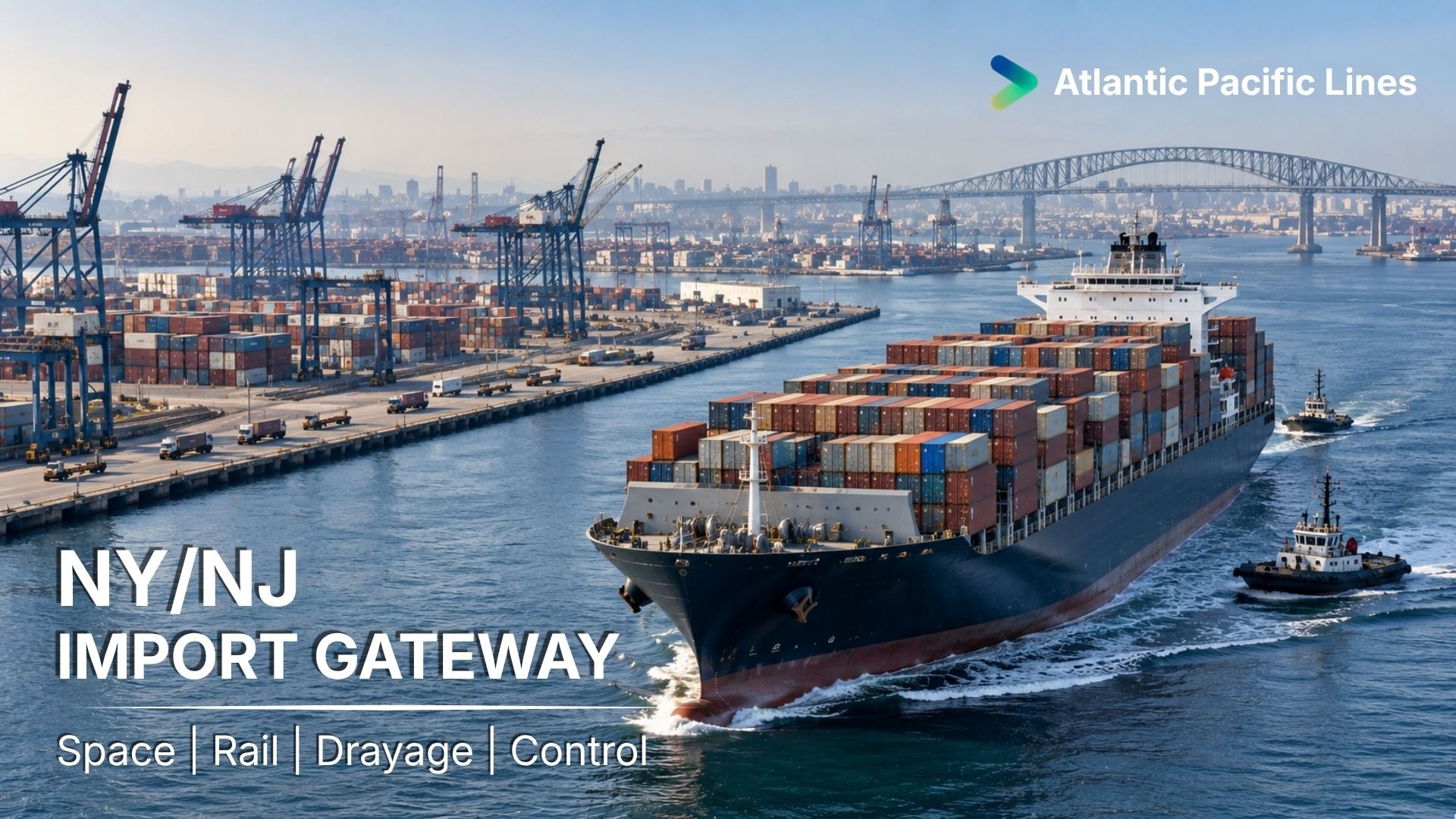
The Port of New York and New Jersey is the busiest container gateway on the United States East Coast and the third-largest in the country, handling around nine million containers a year across terminals in Newark, Elizabeth, Bayonne, and Staten Island. Importing through the Port of New York and New Jersey means reaching the enormous Northeast consumer market at the shortest inland distance, served by on-dock rail and the dense New Jersey warehouse belt, through terminals whose appointments, chassis, and free time govern how smoothly a container moves. Atlantic Pacific Lines, an FMC-licensed NVOCC based in New Jersey, commits guaranteed vessel space allocation into this gateway, with drayage and transload handled at its home port.
For importers serving the eastern United States, the Port of New York and New Jersey is the front door. It is the largest port on the East Coast, sits at the center of the country's densest consumer market, and connects to the interior by some of the best port rail infrastructure in the nation. It is also the home port of Atlantic Pacific Lines and its drayage arm, which means the gateway this guide describes is the one they work every day. This guide explains what the port is and why cargo lands here, the terminals that make it up, the landside system that decides a container's real transit, the rail and warehouse access that make the Northeast reachable, and how securing vessel space into this gateway, and planning the ground side alongside it, keeps a shipment moving through the busiest port on the East Coast.
What the Port of New York and New Jersey is
The Port of New York and New Jersey is not a single pier but a port district spanning the harbor around New York City and northeastern New Jersey, taking in a system of marine terminals across Newark, Elizabeth, Bayonne, and Staten Island. It has long been the busiest port on the East Coast, and in recent years it has at times ranked as the busiest container port in the entire United States by volume, handling on the order of nine million containers a year. The heart of the container operation sits on the New Jersey side, at the Port Newark and Elizabeth marine terminals, which together form the busiest container-handling complex on the East Coast.
The port's ability to take the largest modern vessels was transformed by the raising of the Bayonne Bridge, which lifted the clearance into the harbor's main terminals and allowed the ultra-large container ships that now serve the East Coast to call here. Combined with deep-water berths, that access is part of why cargo has shifted toward the East Coast in recent years, and why the Port of New York and New Jersey has grown into the role it holds today. For a shipper, the practical point is that this is a full-scale gateway capable of handling any cargo that moves by container, at the doorstep of the Northeast market.
The terminals that make up the port
Like the West Coast complex, the Port of New York and New Jersey is a set of separately operated terminals rather than one facility, and which terminal a container lands at shapes how it moves. The major container terminals cluster on the New Jersey side around Newark and Elizabeth, with additional capacity in Bayonne and on Staten Island.
| Terminal | Location | Notes |
|---|---|---|
| APM Terminals Elizabeth | Elizabeth, New Jersey | One of the largest terminals on the East Coast, with substantial reefer capacity |
| Maher Terminals | Elizabeth, New Jersey | A large multi-user container terminal in the Port Elizabeth complex |
| Port Newark Container Terminal | Port Newark, New Jersey | A major Newark terminal, handling well over a million containers a year and expanding |
| GCT Bayonne (Port Liberty) | Bayonne, New Jersey | A deep-water terminal able to handle the largest vessels calling the East Coast |
| GCT New York | Staten Island, New York | The main container terminal on the New York side of the harbor, with rail connectivity |
Each terminal runs its own gates, appointment behavior, and empty-return rules, and empty-return locations in particular vary by shipping line and container type, which is a frequent source of confusion and wasted trips. A drayage operation that works these terminals daily knows the current gate schedules, the empty-return picture, and each terminal's quirks, which is precisely the knowledge that keeps a container move from stalling. This is the kind of ground-level, terminal-by-terminal familiarity that only comes from running the port regularly.
Why cargo lands here: the Northeast market and the rail advantage
The reason to route cargo through the Port of New York and New Jersey is what sits behind it. The port has unmatched access to one of the largest and most concentrated consumer markets in the world, tens of millions of people in the immediate metropolitan region and many more across the connected Northeast, all reachable at short inland distance. For cargo consumed in the East, landing here rather than on the West Coast avoids a long transcontinental move and places the goods close to the market from the moment they leave the terminal.
The rail access extends that reach inland. The port operates an on-dock and near-dock rail system that connects directly to the Class 1 railroads serving the eastern and central United States, so cargo can move from the terminal to inland markets by rail without a separate drayage leg to a distant ramp. Alongside the rail sits the dense New Jersey warehouse and distribution belt, one of the largest import logistics markets in the country, stretching from the areas around the port down through the central New Jersey distribution corridor. The combination of a huge local market, direct rail to the interior, and enormous nearby warehouse capacity is what makes this gateway the natural choice for eastern distribution.
The landside system that decides a container's real transit
As at any major gateway, the ocean crossing is the predictable part and the landside is where the real variability lives. Terminals in the port run on appointment systems, so a trucker generally needs a booked slot to retrieve or return a container, and slots tighten on the heavy discharge days after large vessel arrivals. Each container has a limited window of free time at the terminal before demurrage begins, and in a congested week that window can effectively shrink when a pickup appointment is not available in time. Chassis, supplied through pools serving the port, can tighten in peak periods. And customs, freight, and terminal holds must all be cleared before a container is released, so an uncleared hold blocks pickup regardless of the appointment. The charges that catch importers out here are the same ones that catch them everywhere, demurrage and detention, and they accrue in exactly these landside gaps.
One factor specific to the Northeast is worth planning for: winter weather. The months from roughly December through March can bring severe weather that delays vessels and disrupts terminal and truck operations, so shippers moving cargo through the port in winter build extra buffer into their schedules rather than assuming clean timing. It is a small discipline that prevents a predictable seasonal problem from becoming a delivery failure.
Drayage and transload at the home port
Moving the container from the terminal to its destination is drayage, the short-haul truck move between the marine terminal and a warehouse, transload yard, or rail ramp, and in this port it means coordinating the terminal release, the appointment, the chassis, the hold status, and the line-specific empty-return rules. Done well, it is invisible; done poorly, it generates demurrage, detention, and wasted trips. Book Your Cargo, the drayage arm of Atlantic Pacific Lines, works the Port of New York and New Jersey terminals from its New Jersey base, which is the home market for both brands, and that local presence is the difference between a drayage provider that knows the port from a map and one that runs its gates every day.
For cargo bound beyond the immediate region, transload near the port is often the efficient choice. Transloading unpacks the ocean container close to the terminal and reloads the goods into a domestic truck or container, freeing the marine equipment quickly, avoiding detention on carrier boxes, and consolidating cargo for onward distribution across the Northeast and the interior. With the New Jersey warehouse belt right behind the port, transload and warehousing near the terminals is a natural fit for importers moving volume through the gateway, and planning it ahead of arrival is what makes it seamless.
What a move through the gateway actually costs
Budgeting for the Port of New York and New Jersey means counting the full stack of landside costs, not just the drayage rate. On top of the base truck move sit chassis charges for the days the equipment is in use, any terminal fees, the cost of the inland rail or trucking leg, and, when timing slips, demurrage at the terminal and detention on the carrier's equipment. A clean move carries only the predictable items, while a move that stalls on a missed appointment, an uncleared hold, or a wasted empty-return trip accumulates charges fast, so the quality of the drayage operation feeds straight into the landed cost.
The way to protect the budget is to design out the avoidable charges rather than absorb them. Clearing customs before the vessel arrives, securing appointments, watching the free-time clock, and knowing the line-specific empty-return picture prevent the demurrage, detention, and lost trips that make up the difference between a well-run gateway move and a poorly-run one. Because those avoidable charges can exceed the base drayage rate, the importer who plans them out at this gateway is protecting more of the landed cost than the freight rate negotiation ever reaches.
Why importers are choosing the East Coast
A broader shift stands behind the growth of this gateway, and it is worth understanding because it shapes how much cargo now competes for space here. For years, the default for Asian imports was the West Coast, landing at Los Angeles or Long Beach and moving inland by rail. A series of pressures changed that calculus: congestion and labor uncertainty on the West Coast, the raising of the Bayonne Bridge that let the largest ships call the East Coast directly, and the simple fact that a large share of the United States population and consumption sits in the eastern half of the country. Many importers responded by shifting volume to all-water services into East Coast ports, and the Port of New York and New Jersey, as the largest of them, absorbed much of that growth.
For a shipper planning today, the consequence is twofold. The gateway is deeper and better connected than it has ever been, capable of handling the largest vessels and moving cargo inland efficiently by rail. But it is also busier and more contested than it once was, so space into the port, and appointments and chassis at its terminals, cannot be taken for granted the way they might have been a decade ago. The East Coast shift made this gateway more valuable and more crowded at the same time, which is precisely why committed space and planned drayage matter more here now than they used to.
Customs, holds, and foreign trade zones
Clearing customs cleanly is part of moving through any United States gateway, and a few points specific to a high-volume port like this one are worth planning for. Accurate classification and a clean entry keep a container from being held, and customs, freight, and terminal holds must all be resolved before the box is released, so an unresolved hold blocks pickup no matter how good the drayage plan is. Clearing the entry before the vessel arrives, so release is ready the moment an appointment opens, is the single most effective way to avoid the demurrage that congested terminals generate.
The New Jersey region around the port also offers an extensive network of foreign trade zones and bonded facilities, which let importers defer or manage duties on goods held near the port before they formally enter United States commerce. For importers holding inventory, staging cargo for distribution, or managing duty on high-value goods, locating that activity in a foreign trade zone near the gateway can be a meaningful cost and cash-flow tool. It is a specialized decision that depends on the cargo and the business, but the density of such facilities around the Port of New York and New Jersey is one more reason the gateway suits importers building distribution around the Northeast.
Reefer and specialized cargo through the gateway
Beyond dry containers, the Port of New York and New Jersey is a major gateway for refrigerated and specialized cargo, and that capability is worth knowing for importers whose goods need more than a standard box. The port's terminals carry substantial reefer capacity, with powered slots for refrigerated containers, serving the large Northeast market for imported food, produce, pharmaceuticals, and other temperature-sensitive goods. Refrigerated cargo runs on tighter tolerances than dry freight, because a delay in pickup is not only a demurrage question but a cold-chain one, so reefer containers reward especially careful planning of the appointment and the drayage against the actual discharge, with the destination cold storage lined up before the vessel arrives.
The gateway also handles the range of specialized moves a full-scale port supports, from oversized and heavy cargo to shipments with particular handling or compliance requirements. For any of these, the landside plan matters more than for ordinary dry freight, because the equipment, the appointment, and the destination all have to align on a narrower margin. The general principle holds across all of it: the more specialized the cargo, the more the container's real transit depends on a drayage and delivery plan built against the true arrival, and the more a home-port operation that knows the terminals and the equipment pays for itself.
How vessel space into the gateway ties it all together
All of the landside planning depends on the container arriving, and the East Coast lanes that feed the Port of New York and New Jersey have their own capacity pressures. All-water services from Asia via the Panama Canal, and the direct trades from Europe and the Indian subcontinent, all land here, and each tightens in its own season, a dynamic covered in our guides to the Europe to United States lane and the United States and India trade. When a lane tightens, uncommitted cargo into the gateway is the first to roll. Atlantic Pacific Lines books against direct service contracts with major ocean carriers and commits vessel space into the Port of New York and New Jersey, with equipment planned into the commitment, so a shipper's cargo holds its sailings into the gateway while uncommitted bookings compete for what remains.
Joining the committed ocean space to the planned landside is the whole point, and it is especially natural at this port because it is the home base. An importer whose cargo lands here can have the committed space, the drayage, and the transload managed as one connected movement by a provider that works the gateway daily, which is what turns the busiest East Coast port from a source of delay into a controlled step from vessel to final door.
How to import smoothly through the Port of New York and New Jersey
A short set of habits keeps cargo moving through the East Coast's busiest gateway.
- Secure committed vessel space into the port ahead of each lane's peak, since uncommitted cargo into a busy gateway is the first to roll when a lane tightens.
- Know which terminal your cargo lands at, since gates, appointments, and empty-return rules differ across the Newark, Elizabeth, Bayonne, and Staten Island terminals.
- Use the port's rail and the nearby New Jersey warehouse belt deliberately, routing inland cargo by on-dock rail and transloading near the port where it fits.
- Plan drayage and appointments against the actual arrival, working with an operation that runs the port's terminals daily and knows the line-specific empty-return picture.
- Watch the free-time clock and clear customs and holds early, so the container releases the moment an appointment is available.
- Build winter buffer into schedules from December through March, when Northeast weather can delay vessels and terminals.
Importers who plan the gateway this way make the largest East Coast port a reliable step rather than a bottleneck. It is the basis on which Atlantic Pacific Lines, from its New Jersey home, commits space into the Port of New York and New Jersey and coordinates the drayage and transload behind it, so cargo moves from vessel to final door as one plan.