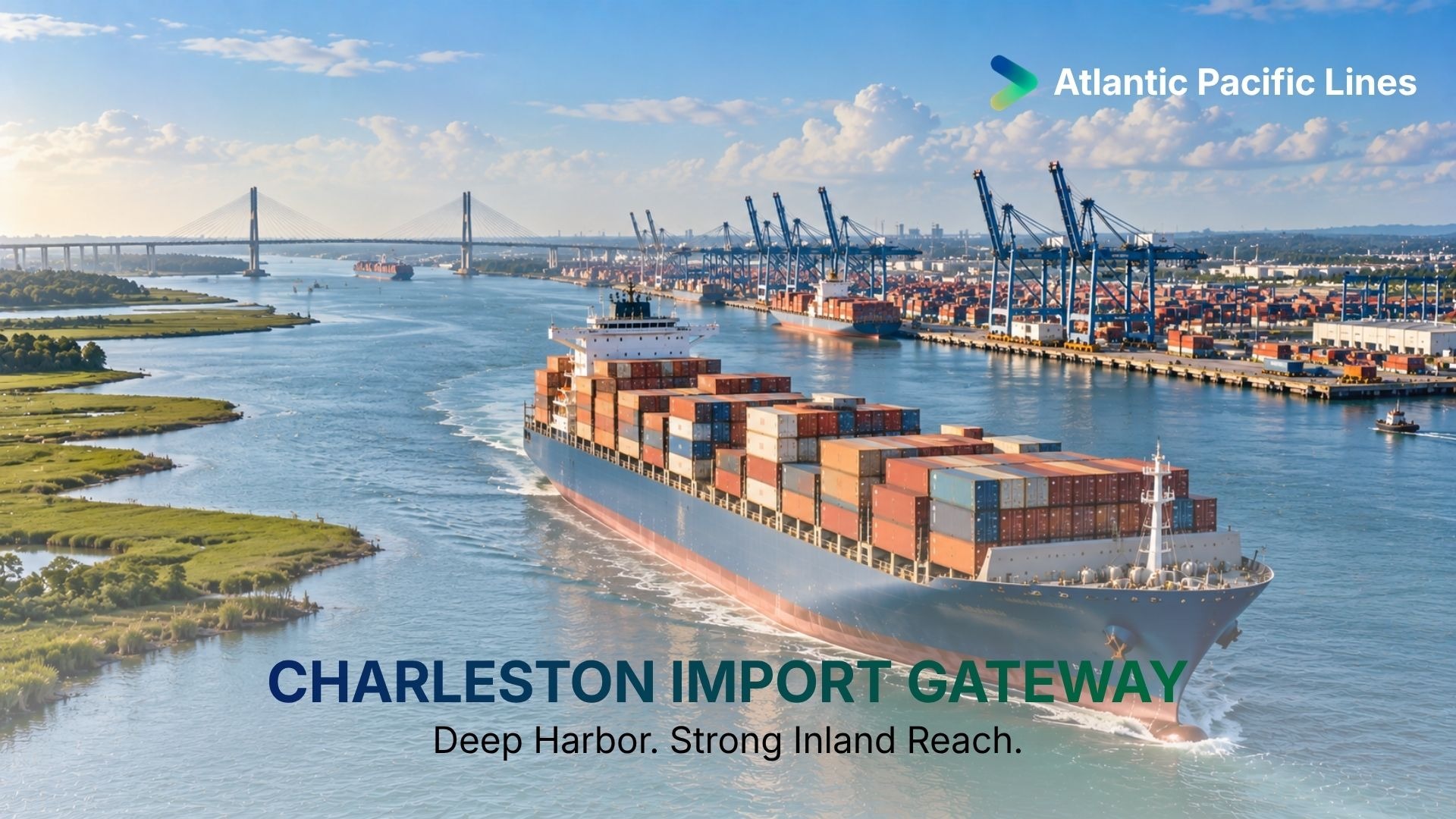
The Port of Charleston, operated by the South Carolina Ports Authority, is one of the deepest container harbors on the United States East Coast and a fast-growing gateway to the booming Southeast manufacturing and consumer market. Importing through Charleston means deep-water access for the largest vessels, a growing set of terminals led by Wando Welch, and strong inland rail connections to the Southeast interior, paired with the same landside discipline any gateway demands. Atlantic Pacific Lines, an FMC-licensed NVOCC, commits guaranteed vessel space allocation into this gateway, with drayage and transload behind it.
For importers serving the Southeast, and for cargo that needs a deep East Coast harbor, the Port of Charleston has become one of the region's most important gateways. It offers some of the deepest water on the East Coast, it sits in the middle of one of the country's fastest-growing manufacturing and distribution regions, and it has invested heavily in terminals and inland rail to keep pace with that growth. This guide explains what the Port of Charleston is, why its deep harbor matters, the terminals that make it up, the Southeast market and inland rail behind it, the landside system that governs a container's real transit, the drayage and transload options, and how securing vessel space into this gateway keeps a shipment moving.
What the Port of Charleston is
The Port of Charleston is a complex of marine terminals on the harbor at Charleston, South Carolina, operated by the South Carolina Ports Authority, a state agency that runs the port as a single gateway. It is one of the busiest container ports on the United States East Coast and among the busiest in the country, handling millions of containers a year, and it has grown quickly on the strength of the Southeast's expanding economy. The port's defining physical advantage is depth: Charleston offers one of the deepest harbors on the East Coast, which allows it to take the largest container vessels now calling the coast without the tidal restrictions that constrain shallower ports.
That depth is a strategic asset in an era of ever-larger ships. As the biggest vessels have shifted onto East Coast services, ports able to handle them at any tide have an advantage, and Charleston's harbor depth places it among the East Coast gateways best positioned for that trade. Combined with a location in the heart of a fast-growing region and a state authority investing steadily in capacity, the deep harbor is a large part of why cargo has moved toward Charleston in recent years.
The terminals that make up the port
Charleston's container operation runs across a set of terminals on the harbor, managed as one gateway by the state ports authority. The mix of an established main terminal and newer capacity gives the port room to grow with the region it serves.
| Terminal | Focus | Notes |
|---|---|---|
| Wando Welch Terminal | The main container terminal | The port's largest and busiest container facility, handling the bulk of Charleston's containerized cargo |
| Leatherman Terminal | Newer container capacity | A modern terminal adding container capacity and able to handle large vessels, part of the port's growth investment |
| North Charleston Terminal | Container and mixed cargo | An established terminal supporting the port's container and general cargo operations |
Wando Welch Terminal is the port's largest and busiest container facility, handling the bulk of Charleston's containerized cargo, while the newer Leatherman Terminal adds modern capacity able to take large vessels and represents the port's investment in future growth. North Charleston Terminal supports container and mixed cargo. As with any multi-terminal gateway, which terminal a container lands at shapes how it moves, so a shipper who knows the terminal can plan the appointment, the drayage, and the timing rather than discovering the specifics at the gate. The state authority's single-gateway management helps coordinate across the terminals, which is part of Charleston's operational reputation.
The Southeast market and the inland rail advantage
The reason to route through Charleston is the region behind it. The Southeast has become one of the most active areas in North America for manufacturing investment, warehousing, and distribution-center development, anchored by the automotive and tire industries, aerospace, and a broad base of consumer distribution. Charleston sits in the middle of this growth, serving South Carolina's own manufacturing base and the wider Southeast, and much of the cargo moving through the port is tied to the region's factories, both the components arriving to feed them and the finished goods leaving them.
The inland reach extends that market well beyond the coast. South Carolina operates inland ports, rail-served terminals in the interior that connect to Charleston by rail, which bring port services closer to distribution and manufacturing deep inland and let cargo move by rail rather than a long truck leg. This inland-port strategy, a model that has driven the growth of the modern Southeast gateways, extends Charleston's catchment into the upstate and into neighboring states, and it is central to how the port competes for cargo bound inland rather than only for cargo consumed near the coast.
The automotive and manufacturing cluster behind the port
A large part of Charleston's story is the manufacturing cluster that has grown around it, and it gives the port a distinctive cargo character. The Southeast, and South Carolina in particular, has become a center of automotive and tire manufacturing, aerospace, and advanced industry, with major assembly and production facilities drawing components in and shipping finished goods out through Charleston. This industrial base makes the port a two-way gateway in a way a purely consumer-import port is not: it handles the parts and components that feed the region's factories on schedules that cannot easily slip, alongside the finished vehicles, tires, and industrial goods leaving them.
For a shipper, the manufacturing cluster has two implications. First, a meaningful share of the cargo is schedule-sensitive production freight, where a delay affects a line rather than a shelf, which raises the value of committed space and reliable landside execution. Second, the industrial base has pulled a dense network of suppliers, warehouses, and distribution centers into the region around the port, which makes Charleston well suited to shippers building distribution or supporting manufacturing in the Southeast. The port's growth and the region's industrial growth reinforce each other, and an importer planning a Charleston program is planning around a genuine and expanding production economy.
Why the shift toward the East Coast favors Charleston
Charleston's growth is part of the broader movement of cargo toward the United States East Coast, and understanding it helps a shipper see why the gateway matters more now than it once did. For years the default for Asian imports was the West Coast, but congestion and labor uncertainty there, the ability of larger ships to reach the East Coast, and the concentration of population and consumption in the eastern half of the country moved volume toward all-water East Coast services. Charleston, with its deep harbor able to take the largest ships and its position in the fast-growing Southeast, captured a share of that shift.
For a shipper planning today, the consequence is that Charleston is deeper and better connected than ever, but also busier and more contested. The volume that has moved east competes for the same space, appointments, and chassis, so the capacity that might once have been taken for granted now has to be secured, especially in peak periods. The East Coast shift made Charleston more valuable and more crowded at the same time, which is exactly why committed space and planned landside capacity matter more here now than they did a decade ago, and why treating the gateway as a managed step rather than an assumption is the right posture.
Charleston within the South Atlantic range
The South Atlantic has several deep gateways within reach of the Southeast, and importers weigh them against one another much as transpacific shippers weigh the coasts. Charleston's case rests on its harbor depth, its inland-port reach into the upstate and neighboring states, and its reputation for fluid operations at a time when the largest gateways tend to carry the most congestion. For cargo bound for South Carolina, the Carolinas broadly, and much of the inland Southeast, Charleston often sits closest to the destination and the manufacturing base it serves, which shortens the inland leg and the cost that rides on it, and that proximity is a large part of the port's appeal for regional distribution.
The decision is rarely absolute, and the discipline that serves a shipper best is the same multi-gateway posture that governs the coast decision on the transpacific: route by destination, by the inland path, and by the space and reliability available on each gateway in a given season, rather than defaulting to one port out of habit. An importer who treats Charleston as one strong option within the South Atlantic range, matched to the cargo it serves best, captures its deep-harbor and inland-rail advantages without being left exposed when a single gateway tightens, which is the essence of planning a resilient East Coast program rather than a fragile one.
What a move through the gateway actually costs
Budgeting for Charleston means counting the full stack of landside costs, not just the drayage rate or the ocean freight. On top of the base truck move sit chassis charges for the days the equipment is used, any terminal fees, the cost of the rail or inland leg, and, when timing slips, demurrage at the terminal and detention on the carrier's equipment. A clean move carries only the predictable items, while a move that stalls on a missed appointment or an uncleared hold accumulates charges quickly, so the quality of the drayage and the discipline of the customs clearance feed straight into the landed cost.
The way to protect the budget is to design out the avoidable charges rather than absorb them. Clearing customs before the vessel arrives, securing appointments, watching the free-time clock, and choosing between rail and drayage deliberately prevent the demurrage, detention, and wasted moves that separate a well-run gateway pass from a poorly-run one. Because those avoidable charges can exceed the base drayage rate, the shipper who plans them out at Charleston is protecting more of the landed cost than the freight negotiation alone ever reaches, and doing so at a fast-growing port where capacity is in demand is what keeps cost predictable through the busy weeks.
The landside system that governs a container's transit
The ocean crossing is the predictable part; the landside is where the variability lives. Terminals run on gate and appointment systems, chassis are supplied through pools that can tighten in busy periods, a container has limited free time before demurrage begins, and customs, freight, and terminal holds must all be cleared before release. The charges that catch importers out, demurrage and detention, accrue in the gaps when any of these misalign, and building each move backward from the cutoffs and the free-time clock matters at Charleston as much as anywhere.
Charleston has a reputation for efficient, fluid operations relative to the largest congested gateways, which is part of its appeal, but efficiency is not immunity. In the busiest weeks, or when the region's fast growth meets a capacity constraint, the same appointment, chassis, and free-time pressures appear here as at any gateway. And for cargo moving inland by rail to an inland port, the rail interchange becomes the critical handoff, just as the drayage move is for local cargo. The importers who move cleanly through Charleston plan the landside against the actual arrival and for the specific inland path, rather than assuming the port's fluidity will absorb whatever arrives.
Refrigerated and specialized cargo through the gateway
Beyond dry containers, Charleston handles a meaningful refrigerated and specialized trade, and that capability matters for importers whose goods need more than a standard box. The Southeast is a large and growing market for imported food, produce, and other temperature-sensitive goods, and the port carries reefer capacity with powered slots to serve it. Refrigerated cargo runs on tighter tolerances than dry freight, because a delay in pickup is not only a demurrage question but a cold-chain one, so reefer containers reward especially careful planning of the appointment and the drayage against the actual discharge, with the destination cold storage lined up before the vessel arrives.
The port also supports the range of specialized moves a full-scale gateway handles, from the automotive and industrial cargo tied to the region's manufacturing to project and oversized shipments. For any of these, the landside plan matters more than for ordinary dry freight, because the equipment, the appointment, and the destination all have to align on a narrower margin. The general principle holds across all of it: the more specialized the cargo, the more the container's real transit depends on a drayage and delivery plan built against the true arrival, and the more local gateway knowledge pays for itself.
Drayage and transload at the gateway
Getting the container from the terminal to its destination is drayage, the short-haul truck move between the marine terminal and a warehouse, transload yard, or rail ramp, and at Charleston it means coordinating the terminal release, the appointment, the chassis, and the hold status. For cargo staying in the Southeast, that is often a move to one of the many distribution centers that have grown up around the port and the region. Book Your Cargo, the drayage arm of Atlantic Pacific Lines, provides the drayage and coordination that keep the final mile from undoing a clean ocean crossing.
For cargo bound beyond the immediate region that is not moving inland by rail, transload near the port can be the efficient choice, unpacking the ocean container close to the terminal and reloading the goods into a domestic truck or container, which frees the marine equipment quickly and avoids detention on carrier boxes. With the Southeast's dense and growing warehouse market behind the port, transload and warehousing near the terminals pairs naturally with port drayage for importers moving volume through Charleston, and planning it ahead of arrival is what makes it seamless.
Inland ports and foreign trade zones: extending the gateway
Two features extend Charleston's reach beyond the harbor and are worth building into a program. The first is the inland-port network already noted: rail-served terminals in the South Carolina interior that connect to the port, letting cargo move by rail to a point much closer to its inland destination before it ever touches a truck. For an importer whose distribution or manufacturing sits inland, receiving a container at an inland port rather than draying it from the marine terminal can cut both cost and road miles, and building that option into the routing is part of using Charleston to its full advantage.
The second is the network of foreign trade zones and bonded facilities around the port and the region. These let importers defer or manage duties on goods held near the port before they formally enter United States commerce, which for businesses holding inventory, staging distribution, or managing duty on high-value or high-volume goods can be a meaningful cost and cash-flow tool. Combined with the manufacturing cluster and the inland ports, the trade-zone network makes the Charleston region a place to structure a supply chain, not merely a port to pass cargo through. A shipper planning a Charleston program should weigh where in this system, marine terminal, inland port, or trade zone, each part of its cargo is best received.
How vessel space into the gateway ties it all together
All of the landside planning depends on the container arriving, and Charleston is fed by the same contested lanes as the other East Coast gateways: all-water services from Asia via the Panama Canal, and direct trades from Europe and the Indian subcontinent. When a lane tightens, uncommitted cargo into the gateway is the first to roll. Atlantic Pacific Lines books against direct service contracts with major ocean carriers and commits vessel space into the Port of Charleston, with equipment planned into the commitment, so a shipper's cargo holds its sailings while uncommitted bookings compete for what remains. The East Coast lanes that feed Charleston, and their seasons, are covered in our guides to the Europe to United States lane and the United States and India trade.
Joining the committed ocean space to the planned landside is the point. Committed space that lands into a gateway with no chassis, no appointment, and no drayage or rail plan waiting simply relocates the delay from the water to the gate. The importers who move cleanly through Charleston secure the space into the port and plan the terminal, the rail or drayage, and the transload as one connected movement from origin to final door, which is how a fast-growing gateway stays a fast one for their cargo specifically.
How to import smoothly through the Port of Charleston
A short set of habits keeps cargo moving through the deep-harbor Southeast gateway.
- Secure committed vessel space into the port ahead of each feeding lane's peak, since uncommitted cargo into a busy, growing gateway is the first to roll when a lane tightens.
- Use the inland rail and the South Carolina inland ports deliberately for interior-bound cargo, routing by rail rather than a long truck leg where it fits.
- Know which terminal your cargo lands at, since gates, appointments, and timing differ across Wando Welch, Leatherman, and North Charleston.
- Plan drayage and appointments against the actual arrival, and locate distribution in the Southeast warehouse market near the port where it fits the network.
- Watch the free-time clock and clear customs and holds early, so the container releases or transfers to rail promptly.
- Plan for the port's growth, treating peak periods at a fast-expanding gateway as times when space and landside capacity must be locked in advance.
Importers who plan the gateway this way turn one of the East Coast's deepest and fastest-growing ports into a reliable step rather than a bottleneck. It is the basis on which Atlantic Pacific Lines commits space into the Port of Charleston and coordinates the drayage and transload behind it, so cargo moves from vessel to final door as one plan.