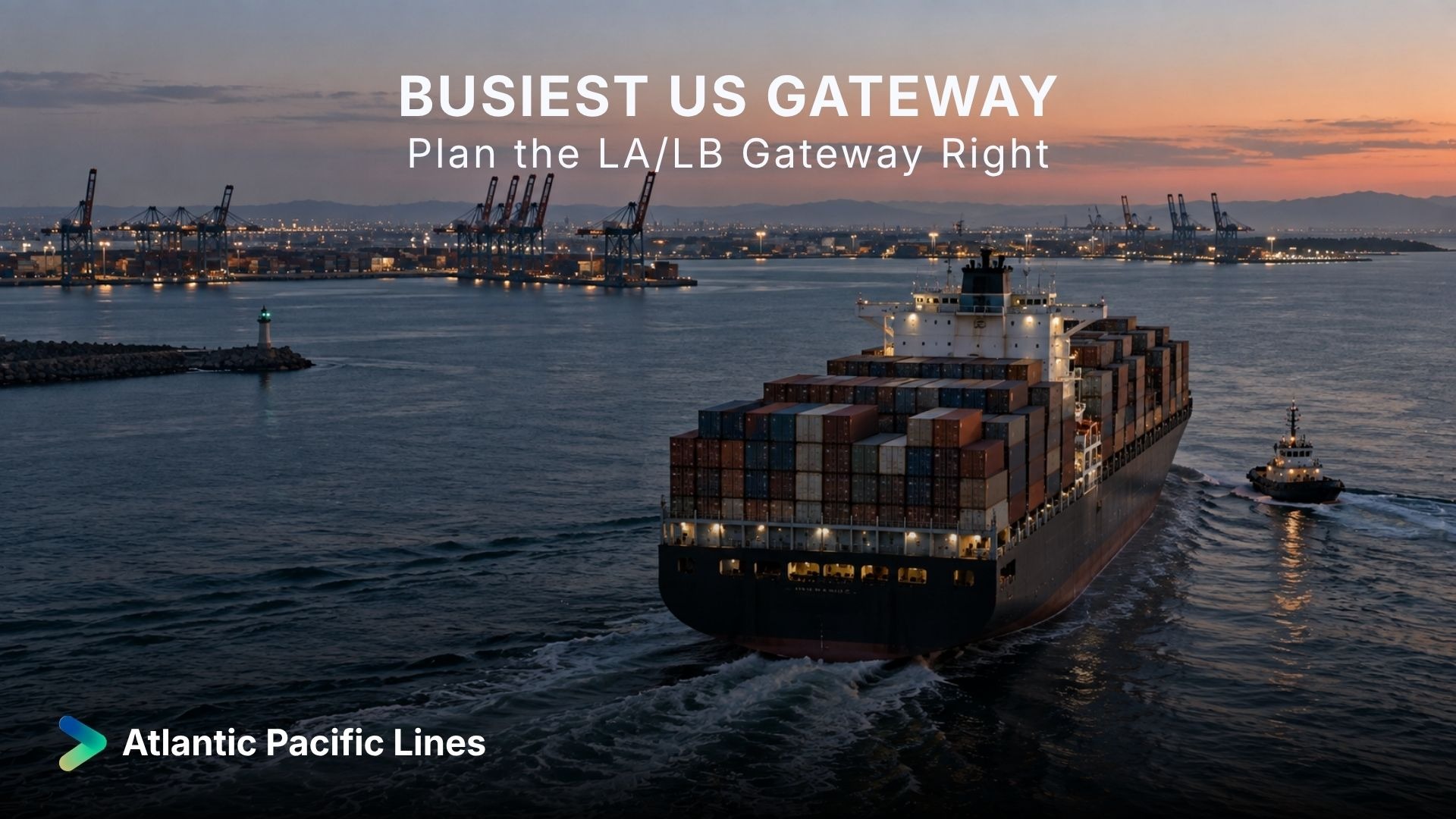
The Ports of Los Angeles and Long Beach form the San Pedro Bay complex, the busiest container gateway in the United States, handling roughly a third of the country's containerized imports and the largest share of transpacific volume. Importing through Los Angeles and Long Beach means clearing not just the ocean transit but a demanding landside system of terminal appointments, chassis supply, free time, and clean-truck rules, where landed cost is protected or quietly lost. Atlantic Pacific Lines, an FMC-licensed NVOCC, commits guaranteed vessel space allocation into this gateway, and its drayage arm handles the final mile across Southern California.
For a huge share of American importers, the journey of an ocean container ends, or nearly ends, at Los Angeles or Long Beach. The two ports sit side by side on San Pedro Bay and together move more containers than any other gateway in the country, which makes them both the fastest way into the United States West Coast and one of the most operationally complex places to move a box through. This guide explains what the San Pedro Bay complex is, why so much cargo lands here, the landside system that decides how smoothly a container actually moves, the drayage and transload options for the final mile, and how securing vessel space into this gateway, and planning the ground side alongside it, keeps a shipment from stalling at the busiest port in the nation.
What the San Pedro Bay complex is
The first thing to understand is that Los Angeles and Long Beach are two separate ports, not one. The Port of Los Angeles and the Port of Long Beach are legally and operationally distinct, each with its own administration and its own terminals, but they share the same waterway on San Pedro Bay and function, from a shipper's point of view, as a single vast gateway complex. The Port of Los Angeles has long been the busiest container port in the United States by volume, and the Port of Long Beach is close behind and posted record throughput in recent years, so between them they anchor the West Coast's container trade. Together they are often described as handling roughly a third of all containerized imports into the United States, which is why what happens here ripples through supply chains nationwide.
The complex is served by a large set of marine terminals operated by different companies, including facilities such as APM Terminals at Pier 400, TraPac, Everport, and Yusen Terminals on the Los Angeles side, and Long Beach Container Terminal, Total Terminals International, Pacific Container Terminal, and others on the Long Beach side. Each terminal runs its own gates, its own appointment behavior, and its own discharge schedule, which matters because a container's experience depends heavily on which terminal it lands at. A shipper who knows only that cargo is arriving at the ports, but not which terminal, is missing the detail that actually governs the pickup.
Why so much cargo lands here
The San Pedro Bay complex is the natural first landfall for transpacific cargo, and the reasons are geography and infrastructure together. The West Coast is the shortest ocean distance from Asia, and Los Angeles and Long Beach sit at the center of it with the deepest concentration of services, so the great majority of direct transpacific loops call here. For cargo destined for Southern California's enormous consumer market, that is the end of the journey. For cargo bound inland, the ports are the gateway to the rail landbridge that carries containers to the Midwest and beyond, moving on dedicated rail infrastructure out of the port complex to the inland rail yards and onward across the country.
Behind the ports sits one of the largest warehouse and distribution markets in the world, the Inland Empire to the east, where Ontario, San Bernardino, Riverside, and the surrounding communities hold a vast concentration of import distribution centers. This combination, the shortest ocean route, the deepest service choice, direct rail to the interior, and an enormous local warehouse market, is why the complex handles the volume it does. It is also why the landside can congest, because all of that cargo funnels through a finite set of terminals, gates, chassis, and trucks.
The landside system that decides how smoothly a container moves
The ocean crossing is the predictable part. The landside is where importing through Los Angeles and Long Beach becomes an operational discipline, and it runs on several layers that all have to align for a container to move cleanly. Terminals in the complex operate on appointment systems, including the Universal Truck Appointment System being extended across the complex, so a trucker generally needs a booked time slot to retrieve or return a container, and those slots grow scarce on the heavy discharge days that follow large vessel arrivals. A container also has a limited window of free time at the terminal before demurrage begins, and in a congested week that free time can effectively shrink, because an appointment to collect the box may not be available before the clock runs out.
| Layer | Where it applies | What it means for your container |
|---|---|---|
| Terminal appointment | Most marine terminals | A time slot must be secured to pick up or return a container, and slots grow scarce on heavy vessel discharge days |
| Free time and demurrage | The marine terminal | A container has a set number of free days at the terminal, after which demurrage accrues, and free time can run out faster than expected in a congested week |
| Chassis supply | Chassis pools serving the complex | The trucker needs a chassis to move the container, and chassis can tighten in peak periods and at inland rail hubs |
| Clean truck and mitigation fees | The San Pedro Bay complex | Emissions and traffic mitigation programs add per-move costs and require compliant equipment, which shapes which carriers can work the port |
| Holds and release | Customs and the terminal | Customs, freight, and terminal holds must all be cleared before a container can be released, and an uncleared hold blocks pickup regardless of appointment |
Two further realities sit underneath the table. Chassis, the wheeled frames that carry containers on the road, are supplied through pools serving the complex, and while availability at the marine terminals is often adequate, chassis can tighten in peak periods and especially at the inland rail hubs. And the complex operates under clean-truck and traffic-mitigation programs, including the Clean Truck Fund Rate and mitigation fees, which add per-move costs and require compliant, low-emission equipment, shaping which carriers can legally work the port. The practical result of all this is that a container's real transit time through the gateway is decided as much by appointment timing, chassis, and hold clearance as by the vessel, and the charges that catch importers out, above all demurrage and detention, accrue in exactly these landside gaps.
What a move through the complex actually costs
Importers planning a budget for the gateway should count more than the drayage rate, because the true cost of moving a container through Los Angeles and Long Beach is a stack of items that the freight quote alone never shows. On top of the base drayage there are the clean-truck and traffic-mitigation fees the complex imposes, chassis charges for the days the equipment is used, any terminal fees, and, where timing slips, demurrage at the terminal and detention on the equipment. A move that goes cleanly carries only the predictable items; a move that stalls on a missed appointment or an uncleared hold picks up charges quickly, which is why the difference between a well-run drayage and a poorly-run one shows up directly in the landed cost.
The practical discipline is to build the gateway's real cost into the plan from the start, rather than discovering it on an invoice. That means knowing the mitigation and clean-truck fees that apply, budgeting for chassis, and, above all, protecting against the avoidable charges by clearing customs early, securing appointments, and moving the container before free time expires. On a gateway this busy, the avoidable charges are often larger than the base rate, so the shipper who plans them out is protecting a bigger share of the landed cost than the freight negotiation ever touches.
Drayage and transload: the final mile at the complex
Getting the container from the terminal to where the cargo is needed is drayage, the short-haul truck move between the marine terminal and a nearby warehouse, transload yard, or rail ramp, and at a complex this size it is a discipline in its own right. A drayage move here means coordinating the terminal release, the appointment, the chassis, and the hold status, and a small misalignment on any one of them turns a routine move into demurrage and delay. Working with a drayage operation that runs the San Pedro Bay gates every day, understands each terminal's behavior, and holds compliant equipment is what keeps the final mile from undoing a clean ocean crossing. This is the work handled by Book Your Cargo, the drayage arm of Atlantic Pacific Lines, across the Los Angeles and Long Beach complex and the wider Southern California market.
For import cargo bound beyond Southern California, transload is often the smarter move than shipping the marine container inland. Transloading unpacks the ocean container near the port and reloads the goods into a domestic truck or a larger domestic container, which frees the marine equipment quickly, avoids inland detention on carrier boxes, and can fit more cargo into each onward move. Pairing transload and warehousing near the port with port drayage is a common pattern for importers moving volume through the complex to national distribution, and planning it in advance rather than at the terminal gate is what makes it work.
The Inland Empire and the inland decision
For cargo that does not stay in the immediate Los Angeles basin, the gateway presents a decision that shapes cost and speed: distribute locally, rail inland, or transload for onward trucking. The Inland Empire, the vast warehouse region east of the ports around Ontario, San Bernardino, and Riverside, holds one of the largest concentrations of import distribution capacity in the world, and for a great deal of cargo the move is a short drayage from the terminal to an Inland Empire warehouse where goods are received, stored, and distributed across the western United States. That short haul is itself a drayage discipline, because the same appointment, chassis, and free-time pressures apply on the way to the warehouse as anywhere else.
For cargo bound for the middle of the country or the East, the choice is between the rail landbridge out of the port complex and transloading for a domestic move. The landbridge loads the marine container onto a train that runs inland to the major rail hubs, and it can be efficient for full-container inland moves when rail capacity is fluid, though it ties the cargo to the marine equipment and the rail schedule. Transloading instead near the port, unpacking into a domestic container or trailer, frees the marine box quickly and can consolidate cargo for a cheaper onward move. Neither is always right, and the choice turns on the destination, the volume, and the state of rail capacity that season, which is exactly the kind of decision an experienced gateway operator helps a shipper weigh rather than default.
Peak season at the busiest gateway
Because Los Angeles and Long Beach are the busiest gateway on the busiest ocean trade, they feel the transpacific peak more sharply than anywhere else, and the landside and the ocean side compound each other. When import demand builds toward the Western retail seasons, and when carriers manage capacity with blank sailings, the sailings serving the complex fill first, and the cargo that does arrive lands in bunched waves that overwhelm terminal appointments, chassis pools, and drayage capacity at the same time. The result is the pattern importers know well: containers that sail late and then sit at a congested terminal accruing charges, a double delay on the water and at the gate.
The defense is to plan both sides ahead of the peak rather than react to it. Committed vessel space secured before the crunch keeps cargo sailing on schedule into the gateway, and drayage and warehouse capacity booked against the expected arrival wave keeps it moving once it lands. Importers who treat the peak as a known annual event, and lock both the space and the ground capacity in advance, move through the busiest weeks while those who wait for the market to tell them it is tight are already behind. The gateway rewards preparation more than almost any other point in the supply chain, because everything funnels through the same finite landside at the same time.
Empty returns and the efficiency of every move
A part of drayage that importers rarely think about, but that decides cost and truck productivity at a busy complex, is the empty container return. After a container is unpacked, the empty has to go back, and where it goes depends on the shipping line and the container type, with return locations that change and occasionally close when a depot or terminal is full. A trucker who arrives to return an empty only to be turned away has burned a trip and a chassis, and at a complex the scale of San Pedro Bay that lost productivity multiplies across a fleet. Knowing the current empty-return picture, line by line and day by day, is unglamorous knowledge that directly affects how much a drayage move costs and how reliably it completes.
The most efficient operations chain moves together, pairing an import pickup with a nearby empty return or an export load so that a truck and its appointment are not wasted on a single one-way trip, a practice known as a dual transaction. Achieving it consistently requires real-time knowledge of terminal conditions, appointment availability, and empty-return status across the complex, which is precisely the operational intelligence that separates a drayage provider running the gates daily from one working off yesterday's information. For a shipper, the payoff shows up as lower per-container cost and fewer surprises, which is why the quality of the drayage operation matters as much at this gateway as the ocean carrier does.
How vessel space into the gateway ties it all together
Everything landside depends on the container actually arriving, and on this gateway, in a peak or a tight market, that is not guaranteed for uncommitted cargo. The transpacific lanes that feed Los Angeles and Long Beach tighten hard in peak season, and the sailings serving the complex fill first because it is the busiest gateway, so cargo without committed space is the cargo that rolls. Atlantic Pacific Lines books against direct service contracts with major ocean carriers and commits vessel space into the San Pedro Bay complex, with the equipment planned into the commitment, so a shipper's cargo holds its sailings into the gateway through the weeks that strand uncommitted bookings. The seasonal mechanics of that squeeze are covered in our guide to guaranteed vessel space from China to the United States in peak season.
The point of joining the two halves, the committed ocean space and the planned landside, is that an importer who does only one of them still loses. Committed space that lands into a gateway where no chassis, no appointment, and no drayage plan await simply relocates the delay from the water to the gate. The importers who move cleanly through Los Angeles and Long Beach are the ones who secure the space into the complex and plan the terminal, the drayage, and the transload as a single connected movement from origin to final door.
How to import smoothly through Los Angeles and Long Beach
A short set of habits keeps cargo moving through the busiest gateway in the country.
- Secure committed vessel space into the complex ahead of the peak, since the busiest gateway fills first and uncommitted cargo rolls when the transpacific tightens.
- Know which terminal your cargo lands at, because appointments, gates, and discharge behavior differ by terminal and govern the pickup.
- Plan drayage and appointments against the actual arrival, not the schedule, and work with an operation that runs the San Pedro Bay gates daily and holds compliant equipment.
- Watch the free-time clock from the day of discharge, and clear customs and any holds early so the container can be released the moment an appointment is available.
- Consider transload near the port for cargo bound inland, to free marine equipment quickly and avoid detention on carrier containers.
- Budget for the clean-truck and mitigation fees and the chassis reality, so the landed cost is built with the gateway's real charges rather than the freight rate alone.
Importers who plan the gateway this way turn the busiest port in the nation from a bottleneck into a managed step. It is the basis on which Atlantic Pacific Lines commits space into Los Angeles and Long Beach and coordinates the drayage and transload behind it, so cargo moves from vessel to final door as one plan.