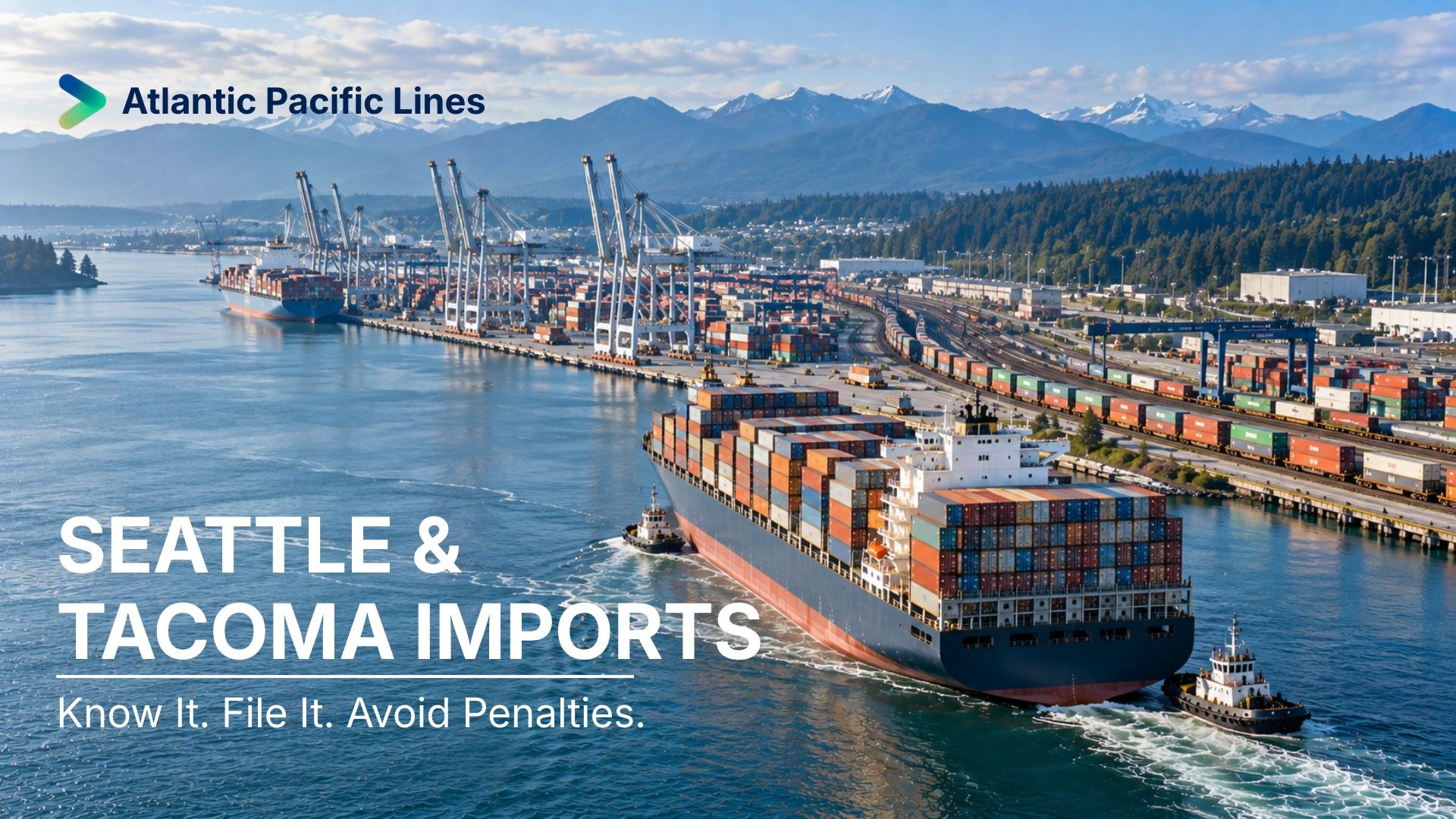
The Seattle and Tacoma gateway, operated jointly as the Northwest Seaport Alliance, is one of the largest container gateways in the United States and the Pacific Northwest's main door to Asia. Its defining advantages are the shortest mainland transit from North Asia and a rail-first design that moves the majority of its import containers inland to the Midwest and beyond. Importing through Seattle and Tacoma means pairing that fast Asia crossing and strong rail with the same landside discipline any gateway demands. Atlantic Pacific Lines, an FMC-licensed NVOCC, commits guaranteed vessel space allocation into this gateway, with drayage and transload behind it.
For cargo bound from Asia to the northern and central United States, the Seattle and Tacoma gateway is often the fastest and most efficient path, and it is one of the most distinctive gateways in the country. Two historic ports run their container operations as a single system, the crossing from North Asia is the shortest to the mainland, and the gateway is built around rail more than local distribution. This guide explains what the gateway is, why its Asia transit advantage is real, the rail-intermodal design that defines it, the landside system that governs a container's actual transit, the drayage and transload options, and how securing vessel space into this gateway keeps a shipment moving through the Pacific Northwest's main port.
What the Seattle and Tacoma gateway is
The Port of Seattle and the Port of Tacoma are two separate, historic ports on Puget Sound in Washington State, formed early in the twentieth century to establish public control of their waterfronts. In 2015 they combined their marine cargo operations into the Northwest Seaport Alliance, a partnership approved by the Federal Maritime Commission that manages the container, breakbulk, auto, and some bulk terminals across both harbors as one gateway. The two ports remain distinct entities, but for a shipper they function as a single system, often described as the North Harbor in Seattle and the South Harbor in Tacoma, which together form one of the largest container gateways in the United States and rank among the busiest by volume.
The partnership matters to shippers because it gives the gateway scale and flexibility that neither port would have alone. Container terminals across both harbors are marketed and operated together, which means more berth capacity, more terminal choice, and a single gateway relationship rather than two competing ones. The alliance also anchors the regional economy, supporting hundreds of thousands of jobs and billions in output across Washington, which is part of why it continues to invest in terminal capacity to handle larger vessels well into the future. That investment is practical rather than cosmetic: modernized berths and deepened channels let the gateway accept the largest container vessels now serving the transpacific, and a shipper booking into a terminal built for those ships gains the schedule reliability that comes with a berth designed for current vessel sizes rather than one straining to accommodate them.
Why the Asia transit advantage is real
The Seattle and Tacoma gateway's headline advantage is geographic and genuine: it offers the shortest ocean transit from North Asia to the mainland United States. The reason is the shape of the earth. The great-circle route, the shortest path across a sphere, arcs north from Asia toward the Pacific Northwest rather than running straight east to Southern California, so vessels from North Asian origins reach Puget Sound sooner than they reach the ports farther south. For cargo from China, Japan, South Korea, and Taiwan, that can mean a meaningfully faster crossing, which is a real advantage for time-sensitive freight.
That speed is why the gateway draws the North Asian trades so strongly, and it interacts with the routing decision every transpacific importer faces. A shipper weighing the Pacific Northwest against the Southern California complex is weighing the fastest northern crossing against the deepest service choice and the largest local market, a comparison that parallels the coast decision set out in our guide to choosing between the US East and West Coasts for China cargo. For cargo bound inland by rail, the Pacific Northwest's transit edge and its rail strength combine into a compelling case.
| Feature | Detail | Why it matters to shippers |
|---|---|---|
| Two-port partnership | Seattle (North Harbor) and Tacoma (South Harbor) | Container terminals across both harbors are managed as one gateway, giving shippers more berth and terminal options under a single system |
| Shortest Asia transit | Closest mainland US gateway to Asia | The northerly great-circle route makes the Pacific Northwest the fastest mainland crossing from North Asia, a real advantage for time-sensitive cargo |
| Rail-first gateway | Majority of imports move inland by rail | The gateway is built for intermodal, sending a large share of containers to the Midwest and beyond by rail rather than local distribution |
| Alaska and grain roles | Primary link for Alaska trade; major grain exporter | Beyond the Asia container trade, the gateway anchors Alaska supply and moves Midwest grain exports, giving it a balanced two-way profile |
The rail-first design that defines the gateway
More than almost any other major United States gateway, Seattle and Tacoma is built around rail. A large majority of the containers imported through the gateway do not stay in the Pacific Northwest; they move inland by rail to the Midwest, the Ohio Valley, and the East, which makes the gateway an intermodal machine as much as a local port. This design is a deliberate strength: the region's population is smaller than Southern California's, so the gateway competes not on local consumption but on being an efficient, fast inland-distribution path from Asia to the middle of the country.
For a shipper, the rail-first character shapes how the gateway should be used. Cargo bound for the Midwest and beyond can take advantage of the fast Asia crossing and step directly onto rail, often arriving at an inland ramp competitively with, or faster than, a Southern California routing, depending on rail fluidity. But it also means the gateway's performance is tied to rail-network conditions: when rail ramps and intermodal capacity are fluid, the gateway is fast and efficient, and when they congest, the inland leg can add days the ocean schedule does not show. Planning the rail leg deliberately, rather than assuming it, is central to using this gateway well. A shipper who tracks rail fluidity as part of the routing decision, not as an afterthought once the container has already landed, keeps the gateway's inland advantage intact through the weeks when the network is under the most strain.
The two-way trade: Alaska, grain, and the balance it brings
Beyond the Asia container trade, the Seattle and Tacoma gateway carries roles that give it an unusually balanced two-way profile, and they are worth understanding because they shape the gateway's character. The gateway is the primary maritime link between Alaska and the continental United States, handling the great majority of that trade, which gives it a steady domestic flow that most gateways do not have. It is also a major grain exporter, moving corn and soybeans that arrive by rail from the Midwest out to world markets, so the same rail network that carries imports inland carries exports back to the coast.
This two-way balance matters to an importer in a practical way. A gateway that exports heavily, in grain and in the containerized backhaul to Asia, has a different equipment and repositioning pattern than an import-dominated port, which can work in a shipper's favor for empty-container availability. And the steady Alaska trade gives the gateway a baseline of activity that smooths some of the volatility a purely transpacific port would feel. For a shipper, the takeaway is that Seattle and Tacoma is not only an import gateway but a genuine two-way system, and that balance is part of what makes it resilient.
Peak season and Pacific Northwest weather
Two seasonal factors deserve planning on this gateway. The first is the transpacific peak, which the Pacific Northwest feels along with every Asia trade: as import demand builds and carriers manage capacity, the sailings serving the gateway fill, and the rail network that the gateway depends on can tighten at the same time, so the inland leg that is normally an advantage can become a constraint in the busiest weeks. Planning both the ocean space and the rail capacity ahead of the peak is what keeps the gateway's speed advantage intact when it matters most.
The second is weather. The Pacific Northwest sees winter conditions that can affect terminal and rail operations, and the mountain passes that the eastbound rail must cross can face snow and closures that delay inland moves in the coldest months. None of this is severe enough to undermine the gateway, but it is predictable enough to plan around: a shipper moving time-sensitive cargo inland through the winter builds buffer into the rail leg rather than assuming clean timing, the same discipline that applies to weather-exposed routings everywhere. Treating the winter rail leg as a known variable rather than a surprise keeps a predictable seasonal factor from becoming a delivery failure.
What a move through the gateway actually costs
Budgeting for the Seattle and Tacoma gateway means counting the full stack of costs, not just the ocean rate or the drayage. On top of the base moves sit chassis charges for the days the equipment is used, any terminal fees, the cost of the inland rail leg, and, when timing slips, demurrage at the terminal and detention on the carrier's equipment. A clean move carries only the predictable items, while a move that stalls on a missed appointment, an uncleared hold, or a congested rail interchange accumulates charges quickly, so the quality of the coordination feeds straight into the landed cost.
The way to protect the budget is to design out the avoidable charges. Clearing customs before arrival, securing appointments, watching the free-time clock, and planning the rail handoff prevent the demurrage, detention, and delay that separate a well-run gateway pass from a poorly-run one. Because those avoidable charges can exceed the base rate, and because the gateway's whole value proposition is speed and efficient inland movement, protecting that value with disciplined landside planning is what turns the Pacific Northwest's structural advantages into a delivered result rather than a theoretical one.
The landside system that governs a container's transit
The ocean crossing is the predictable part; the landside is where the variability lives. Terminals in the gateway run on gate and appointment systems, chassis are supplied through pools that can tighten in busy periods, a container has limited free time before demurrage begins, and customs, freight, and terminal holds must all be cleared before release. The charges that catch importers out, demurrage and detention, accrue in the gaps when any of these misalign, and building each move backward from the cutoffs and the free-time clock matters here as much as anywhere.
The gateway's rail focus adds a specific landside consideration: the interchange between the marine terminal and the rail network. A container moving inland by rail depends on the on-dock or near-dock rail operation and the intermodal ramp being fluid, and a container staying local depends on the drayage and chassis picture. For cargo transferring to rail, the handoff at the terminal is the critical juncture, and for local cargo it is the drayage move, so the right landside plan depends on where the container is ultimately going. A shipper who knows the inland destination can plan the correct handoff rather than discovering the constraint at the terminal.
Equipment and the empty-container picture
Container equipment is a live factor at this gateway, shaped by its two-way trade. Because the Pacific Northwest exports heavily, in grain by rail and in the containerized backhaul to Asia, the empty-container and repositioning pattern differs from an import-only port, and empties can be drawn toward export loading in ways an importer should anticipate. A booking holds vessel space, but the container the cargo loads into, and the chassis that moves it, are separate commitments, and in tight periods either can be the constraint. Committing equipment alongside the space, rather than assuming it, is part of a complete plan here as on every lane.
On the arrival side, the chassis and equipment that move a container inland or to a local warehouse bind hardest in the busy weeks, and for cargo transferring to rail the equipment picture at the intermodal ramp matters as much as at the marine terminal. A shipper who plans the equipment for the whole journey, the ocean container, the chassis, and the rail handoff, avoids the gap that strands a landed container for want of the piece that moves it. On a gateway whose advantage is speed and efficient inland movement, an unplanned equipment gap gives back exactly the time the fast crossing saved.
Drayage and transload at the gateway
For cargo staying in the Pacific Northwest or transloading for onward movement, drayage is the short-haul truck move between the marine terminal and a warehouse, transload yard, or rail ramp, and it means coordinating the terminal release, the appointment, the chassis, and the hold status across the Seattle and Tacoma harbors. Book Your Cargo, the drayage arm of Atlantic Pacific Lines, provides the drayage and coordination that keep the final mile from undoing a fast ocean crossing, whether the container is staying local or moving to an inland ramp.
For cargo bound beyond the region that is not moving as a marine container by rail, transload near the gateway can be the efficient choice, unpacking the ocean container and reloading the goods into a domestic truck or container, which frees the marine equipment quickly and avoids detention on carrier boxes. Transload and warehousing near the port pairs with drayage for importers distributing from the Pacific Northwest, and planning it ahead of arrival is what makes it seamless. The choice between railing the marine container inland and transloading for a domestic move is one of the central decisions on this gateway, and it turns on the destination, the volume, and rail conditions.
When to choose the Pacific Northwest over Southern California
Because both the Pacific Northwest and Southern California serve transpacific cargo, importers weigh them against each other constantly, and the decision rewards being explicit about what each offers. Southern California brings the deepest concentration of services and sailings, the largest local consumer market in the country, and an enormous nearby warehouse belt, which suits cargo consumed in the West or distributed from a Southern California base. The Pacific Northwest brings the shortest crossing from North Asia and a rail-first design, which suits cargo bound for the Midwest and the interior that benefits from stepping quickly onto intermodal rail. Neither is universally better; each fits a different cargo profile.
The clearest case for the Pacific Northwest is Midwest-bound cargo from North Asia. For a container heading to Chicago, the Ohio Valley, or the upper Midwest, the fast northern crossing plus a strong rail connection can deliver competitively with or faster than a Southern California routing, while sometimes avoiding the congestion that the busiest gateway complex can carry in a peak. The clearest case for Southern California is cargo consumed in the West or needing the deepest service choice. Many sophisticated importers use both, routing by destination and by the capacity and reliability available on each path in a given season, which is the same multi-gateway discipline that governs the East Coast decision and turns two gateways into one flexible system rather than an either-or.
How vessel space into the gateway ties it all together
All of the landside planning depends on the container arriving, and the transpacific lanes that feed Seattle and Tacoma tighten in peak season like every Asia trade. When the transpacific peaks, or when carriers run blank sailing programs, the sailings serving the gateway fill and uncommitted cargo rolls. Atlantic Pacific Lines books against direct service contracts with major ocean carriers and commits vessel space into the Seattle and Tacoma gateway, with equipment planned into the commitment, so a shipper's cargo holds its sailings while uncommitted bookings compete for what remains. The seasonal mechanics are covered in our guide to guaranteed vessel space from China to the United States in peak season.
Joining the committed ocean space to the planned landside, and to the rail leg in particular, is the point at this gateway. Committed space that lands into a gateway where the rail interchange or the drayage is unplanned simply relocates the delay from the water to the ramp or the gate. The importers who move cleanly through Seattle and Tacoma secure the space, plan the rail or drayage handoff for where the cargo is going, and treat the fast Asia crossing and the inland leg as one connected movement from origin to final door.
How to import smoothly through Seattle and Tacoma
A short set of habits keeps cargo moving through the Pacific Northwest gateway.
- Secure committed vessel space ahead of the transpacific peak, since the gateway's sailings fill and uncommitted cargo rolls when the Asia trades tighten.
- Use the gateway's transit and rail strengths deliberately for Midwest-bound cargo, stepping the fast Asia crossing directly onto intermodal rail where it fits.
- Plan the rail leg rather than assuming it, since the inland move depends on ramp and intermodal fluidity that the ocean schedule does not show.
- Know whether your container is railing inland or staying local, so the correct terminal handoff, rail interchange or drayage, is planned in advance.
- Watch the free-time clock and clear customs and holds early, so the container releases or transfers to rail promptly.
- Consider transload near the gateway for regional distribution, to free marine equipment and consolidate onward moves.
Importers who plan the gateway this way turn the Pacific Northwest's speed and rail strength into a delivered advantage rather than an unrealized one. It is the basis on which Atlantic Pacific Lines commits space into Seattle and Tacoma and coordinates the drayage and transload behind it, so cargo moves from vessel to final door as one plan.