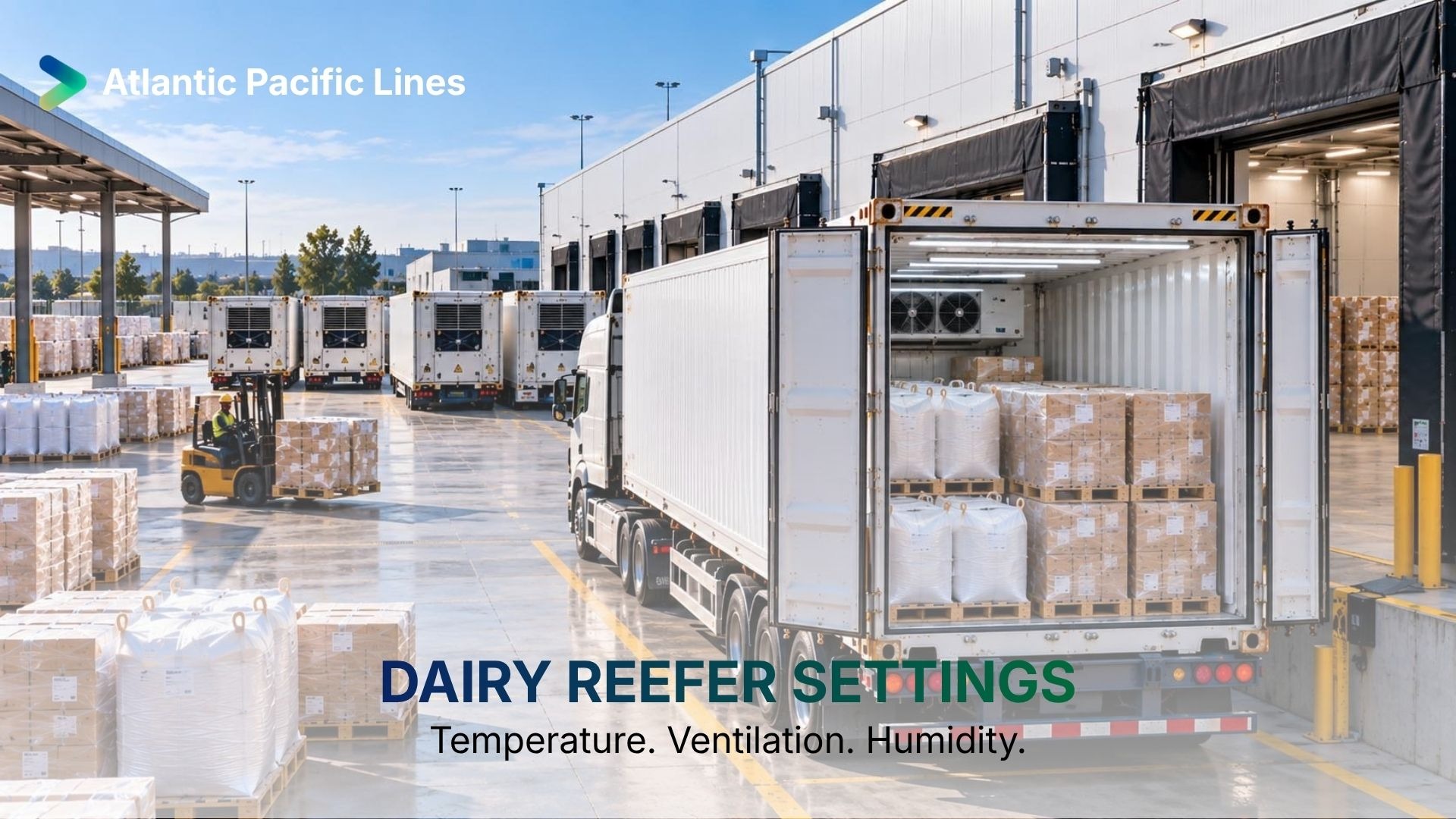
Dairy exports ship at product-specific reefer set points, from chilled cheese just above freezing to deep-frozen butterfat, held steady on an unbroken cold chain from the plant to the overseas buyer. Setting the temperature correctly, keeping the vents closed for non-respiring dairy, and holding the chain unbroken on the inland legs are what deliver the product at specification. Atlantic Pacific Lines, an FMC-licensed NVOCC, books against direct service contracts with major ocean carriers, giving exporters contracted space and priority over spot bookings, subject to space and equipment availability, manages dry and reefer cargo from one desk, and provides generator sets and temperature monitoring on its inland reefer moves.
For exporters of cheese, butter, and frozen dairy, the reefer set point and the cold chain are the whole shipment, because a few degrees of drift or an hour without power can take the product off specification or spoil it outright. Milk powder and whey ship dry and ambient, but everything chilled or frozen runs on temperature control that has to be set correctly and held across weeks of ocean transit and the inland legs on both ends. This guide sets out the reefer set points by dairy product, the difference between chilled and frozen, why dairy ships with the vents closed, how humidity and condensation are managed, and how the cold chain is held unbroken from the processing plant to the buyer.
What a reefer set point is and why it governs dairy
A reefer set point is the single temperature entered into the refrigerated container's system, and for dairy it is held constant for the whole trip rather than adjusted in transit. The container does not cool the cargo down from warm; it maintains cargo that is already loaded at temperature, which is why pre-cooling the box and loading product already at its set point matter as much as the number itself. The set point is chosen from the product, the transit time, and the food-safety requirement, and it is the exporter, not the carrier, who determines the final setting, with carrier figures serving as general guidelines rather than binding instructions.
That distinction matters because dairy is unforgiving of error in either direction. A set point too warm lets chilled cheese or butter soften, sweat, or spoil, while a set point too cold can freeze a product meant to stay chilled and change its texture on arrival. The margin is narrow, the voyage is long, and a product that drifts off specification can be rejected at destination, so the set point is confirmed against the consignee and the product specification before the container is booked, and then held. Getting the number right at booking is the first and largest decision in a dairy reefer shipment.
Reefer set points by dairy product
Different dairy products carry at different temperatures, and the table below gives the general carriage ranges used across the trade. These are industry guidelines rather than fixed settings, so the exporter confirms the exact set point with the consignee and the product specification, but they show the shape of the decision: chilled products held just above freezing, frozen products held well below it, and powders needing no refrigeration at all.
| Dairy product | Typical carriage range | Regime and notes |
|---|---|---|
| Cheese, hard and aged | 0 to 4 degrees C (32 to 39 degrees F) | Chilled; non-respiring; hold steady |
| Cheese, fresh and soft | 0 to 2 degrees C (32 to 35 degrees F) | Chilled; tighter tolerance |
| Butter, chilled | 0 to 2 degrees C (32 to 35 degrees F) | Chilled; for shorter transit |
| Butter and butterfat, frozen | minus 20 to minus 25 degrees C (minus 4 to minus 13 degrees F) | Frozen; for long transit and storage |
| Frozen dairy (ice cream and frozen product) | minus 18 to minus 25 degrees C (0 to minus 13 degrees F) | Deep frozen; non-respiring |
| Milk powder, whey, lactose | Ambient (dry container) | Shelf-stable; no refrigeration needed |
The pattern is clear once the products are grouped. Cheese and chilled butter sit just above freezing, close to zero degrees Celsius, where they stay fresh without freezing. Frozen butter, butterfat, and frozen dairy sit well below freezing, around minus 18 to minus 25 degrees Celsius, for long transit and storage. Milk powder, whey, and lactose are shelf-stable and ship in ordinary dry containers at ambient temperature, outside the reefer question entirely. Knowing which group a product falls into, and the exact set point within it, is what the reefer booking is built on.
Chilled versus frozen: two regimes within the reefer
Within refrigerated dairy there are really two shipping regimes, and they are not interchangeable. Chilled dairy, which covers most cheese and short-transit butter, is held just above freezing to keep the product fresh and workable, and the tolerance is tight because a drift down can freeze it and a drift up can spoil it. The chilled regime suits products that are consumed relatively fresh and shipped on lanes where the transit fits the product's chilled shelf life.
Frozen dairy, which covers butterfat, frozen butter, and frozen product, is held well below freezing, which stops biological activity and gives the cargo a long, stable life for distant markets and long transits. The frozen regime is more forgiving of small fluctuations than the chilled one, because the product is already solid, but it demands a deeper set point and more energy to hold. The choice between chilled and frozen is made from the product, the destination, and the transit time, and it is settled before booking because it determines the set point, the equipment, and the cost.
Why dairy ships with the vents closed
Ventilation in a reefer means fresh-air exchange, the controlled opening of vents that lets outside air circulate through the container. It is essential for fresh fruit and vegetables, which are respiring cargo that give off gases such as ethylene and carbon dioxide and generate heat as they ripen, so the vents are opened to expel those gases. Dairy is different. Cheese, butter, and frozen dairy are non-respiring: they do not give off ripening gases, so they do not need fresh-air exchange, and frozen and non-respiring products are carried with the vents closed.
Closing the vents on dairy serves the shipment in two ways. It holds the cold air inside the box so the set point is maintained with less energy and less fluctuation, and it keeps humid outside air from entering and condensing on cold product and packaging. For dairy, the job of the reefer is a steady temperature and a sealed, stable environment rather than air exchange, which is the opposite of what a container of produce needs. Treating dairy like produce and running the vents open would waste cold, invite moisture, and put the product at risk, which is why the regime is set deliberately for the cargo.
Humidity, condensation, and packaging inside the reefer
Even with the vents closed, moisture has to be managed inside a dairy reefer, because a cold box and temperature changes can produce condensation on the product, the cartons, and the container surfaces. Condensation on packaging can weaken cartons, smear labels, and, on some products, affect the surface of the cargo itself, so the goal is to limit the moisture sealed in at loading and the temperature swings that release it. Loading product already at its set point, pre-cooling the container, and keeping the chain steady all reduce the condensation that forms in the first place.
Packaging and loading do the rest. Dairy is loaded in packaging suited to a cold, sometimes frozen, environment, and the cargo is stowed so the refrigerated air can circulate around it and hold an even temperature rather than leaving warm pockets that sweat. Keeping the cargo off the walls and allowing the designed airflow through the container matters for dairy as it does for any reefer cargo, because an even temperature is a dry, stable one. Managing humidity is less about a target number for dairy than about holding the temperature steady and sealing the box, which together keep moisture from becoming a problem.
Holding the cold chain unbroken, including the inland legs
The set point only protects the cargo if it is held continuously, and the cold chain for a dairy export runs from the processing plant, through the ocean voyage, to the destination cold store, with no gap where the reefer loses power. The ocean leg is the steady part, with the container plugged into the vessel, but the landside legs are where the chain is most exposed, because that is where the box moves between power sources: from plant power to the drayage move, through the terminal, onto the vessel, and the reverse at destination. Every one of those handoffs has to keep the reefer powered and at temperature.
This is where the inland legs decide the shipment. A reefer moving by road or sitting away from fixed terminal or warehouse power needs a generator set to hold its temperature, and without one the cold chain breaks exactly where no one is watching. Atlantic Pacific Lines provides generator sets and temperature monitoring on its inland reefer moves, so the container holds its set point on the drayage and inland legs and the temperature is watched across the move rather than assumed. The demurrage and detention that apply when a box dwells are more than a cost on a reefer, because time without power is a direct threat to the product, which makes tight scheduling part of protecting the cold chain.
Dry and reefer dairy from one desk, filed correctly
A dairy exporter usually ships more than one regime, powder in dry boxes and cheese or butter in reefers, and running them through one provider keeps the program coherent. Atlantic Pacific Lines manages dry and reefer cargo from one desk, so the ambient and the temperature-controlled sides of a dairy program are planned by the same team rather than split across providers, and the reefer equipment, the generator sets, and the inland moves are arranged together. The full picture of the two regimes, the products, and the markets is covered in our guide to shipping dairy products by ocean freight.
Correct commodity filing sits under all of it. Many ocean carriers leave dairy out of their standard general cargo rates, and a booking made as ordinary general cargo can be rejected or billed differently after the fact, which on temperature-controlled cargo is also a cold-chain risk because product prepared for a sailing has to wait. Atlantic Pacific Lines holds dairy commodity programs with multiple major ocean carriers, so dairy is booked under the correct commodity and billed correctly from the start, and the reefer moves on schedule rather than stalling with the clock running on its temperature.
Free time, all-in pricing, and the reefer schedule
Two further parts of the Atlantic Pacific Lines program matter sharply to a dairy reefer. Free time is the period a container can stay at the terminal, or out with the shipper, without charge. Once it runs out, demurrage applies at the terminal and detention applies to the equipment, and on a reefer, every hour of dwell is also time the cold chain is exposed. The programs Atlantic Pacific Lines holds with its ocean carrier partners include extended free time at origin and destination, depending on the carrier and the lane, which gives temperature-controlled cargo more room before those charges and that exposure begin.
The second is pricing that is quick and complete. Atlantic Pacific Lines publishes monthly rate sheets on its regular lanes, turns around fast quotes on new lanes, and prices door to destination with inland trucking included, so a dairy exporter sees one all-in number that already contains the reefer inland leg and its generator-set coverage rather than assembling the ocean, the drayage, and the inland cold chain separately. A reefer move planned and priced end to end spends less time exposed and arrives on specification more reliably than one stitched together from parts.
Shipping chilled or frozen dairy this season? Send Atlantic Pacific Lines your top lanes and get all-in rates back quickly.
How contracted reefer space ties it together
Reefer capacity is tighter and less flexible than dry capacity, so a dairy exporter is exposed to capacity gaps more than most, and a rolled reefer is not only a delay but a cold-chain exposure. Atlantic Pacific Lines books against direct service contracts with major ocean carriers across its vessel space allocation on major trade lanes and gives exporters contracted space and priority over spot bookings, including refrigerated space with the reefer equipment planned into the booking, so contracted cargo is protected ahead of spot cargo when space is short. When a sailing is cut by blank sailings and withdrawn capacity, holding contracted refrigerated space keeps temperature-controlled dairy out of the roll.
Joining the set point and the cold chain to contracted space and the inland coverage is the point. The right temperature means nothing if the reefer loses power on the inland leg or rolls to a later sailing, and a perfect cold chain into a wrongly filed or late booking still loses the cargo. The exporters who ship dairy on specification set the correct set point, book under the correct commodity, hold the cold chain with gensets and monitoring across the inland legs, and build each move backward from the port cutoff dates so the reefer meets its vessel. Because Atlantic Pacific Lines handles the ocean freight, the drayage, and the transload and warehousing itself, the whole cold chain runs through one company.
How to set and hold the dairy cold chain: a checklist
A short set of habits keeps dairy on specification from plant to buyer.
- Classify the product and choose the regime first, since cheese and chilled butter ship just above freezing, frozen butterfat and frozen dairy ship well below it, and powders ship ambient in a dry box.
- Confirm the exact set point with the consignee and the product specification before booking, treating carrier ranges as guidelines rather than fixed settings.
- Pre-cool the reefer and load product already at its set point, since the container maintains temperature rather than cooling warm cargo down.
- Keep the vents closed for non-respiring dairy, and stow the cargo so the cold air circulates evenly and does not leave warm, sweating pockets.
- Hold the cold chain unbroken on the inland legs with generator sets and temperature monitoring, since the landside handoffs are where the chain breaks.
- Book under the correct commodity and secure contracted reefer space ahead of need, so temperature-controlled cargo is not rolled or left dwelling with the clock running on its temperature.
Ready to move your dairy exports?
Atlantic Pacific Lines books dairy exports under the correct commodity with contracted reefer space, sets and holds the cold chain with generator sets and temperature monitoring on inland reefer moves, manages dry and reefer cargo from one desk, and prices the move door to destination with inland trucking included. Send us your top lanes and Atlantic Pacific Lines will come back with all-in rates within 24 hours.