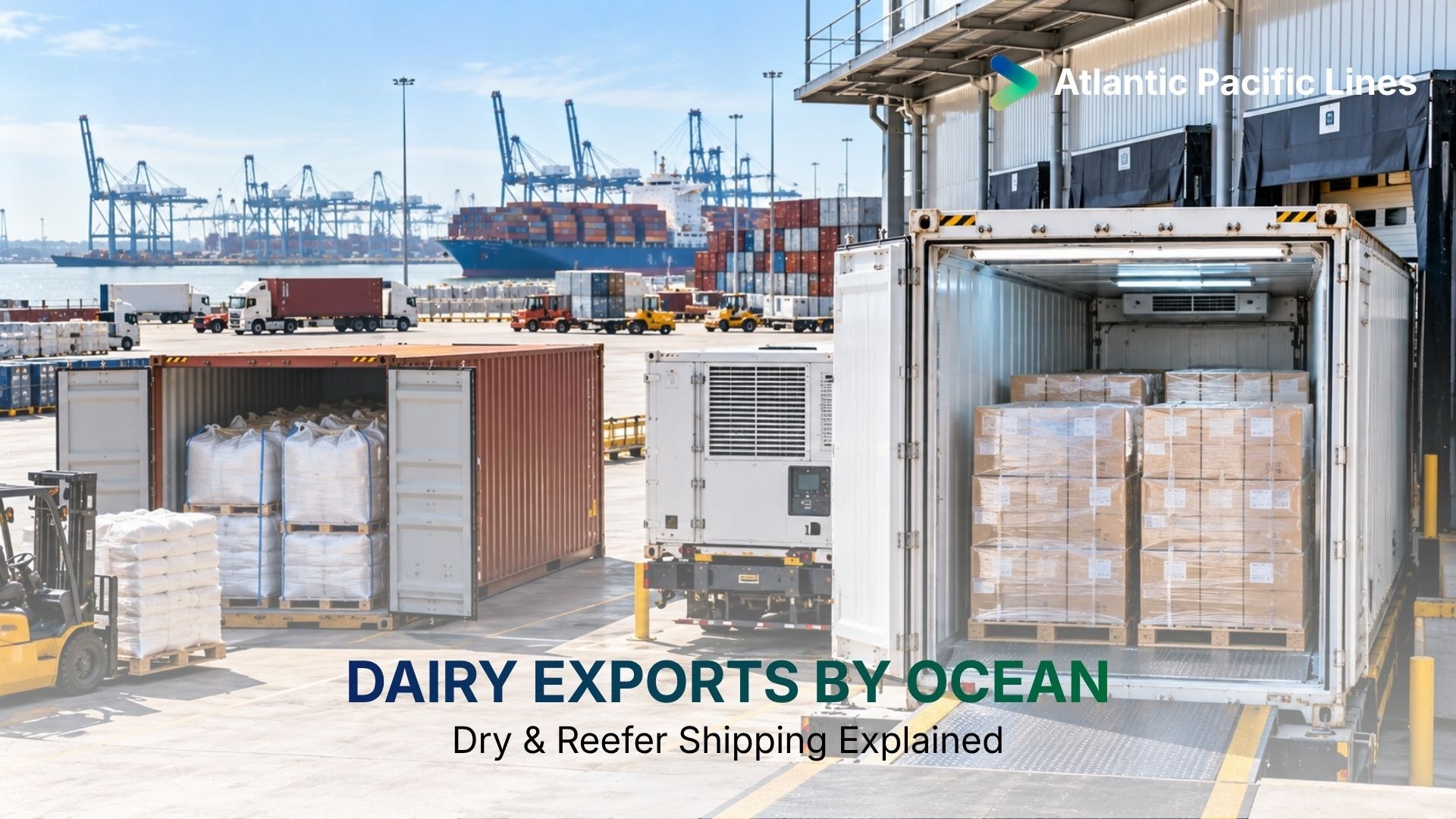
Dairy exports split into two very different shipping problems: shelf-stable powders such as nonfat dry milk and whey that move in ordinary dry containers, and temperature-controlled cheese and butter that move in refrigerated containers on an unbroken cold chain. Shipping dairy well means knowing which problem a product poses and booking ocean capacity correctly for it, because refrigerated slots and equipment are more constrained than dry capacity and the cold chain leaves no room for error. Atlantic Pacific Lines, an FMC-licensed NVOCC, books against direct service contracts with major ocean carriers, giving exporters contracted space and priority over spot bookings, subject to space and equipment availability, manages dry and reefer cargo from one desk, and handles the inland drayage and transload itself, so the move runs through one company.
United States dairy exports have grown into a major trade, with a record set of shipments in a recent year and close to a fifth of domestic milk production now sold overseas. For an exporter, that growth runs on getting the logistics right, because dairy is unforgiving: a powder spoiled by moisture or a cheese shipment that loses its cold chain is a total loss, not a delay. This guide explains the two shipping regimes dairy falls into, why correct commodity booking protects the shipment, the weight that milk powder carries, the cold-chain discipline, the certificates that clear the cargo, the markets that drive the trade, and what Atlantic Pacific Lines does differently to keep dairy booked, billed, and moving intact.
The two shipping regimes dairy falls into
The single most important thing to understand about shipping dairy is that different products travel in completely different ways. Dried dairy, which includes nonfat dry milk, skim milk powder, whole milk powder, whey, lactose, and protein concentrates, is shelf-stable and moves in ordinary dry containers, bagged or in totes, at ambient temperature. These powders are the volume backbone of the dairy export trade, and while they are moisture-sensitive and require a clean, dry, well-sealed container, they do not need refrigeration. The logistics resemble those of other bagged dry commodities more than they resemble fresh dairy.
Chilled and frozen dairy, which includes cheese, butter, and butterfat, is a different trade entirely. These products move in refrigerated containers held at a set temperature from loading through delivery, and they cannot tolerate a break in the cold chain. This is where dairy becomes a reefer problem with all the constraints that implies: fewer slots, specialized equipment, and timing that cannot slip. Recent trade has been driven heavily by exactly these products, with cheese reaching record volumes and butterfat exports surging, which has pushed more of the dairy trade onto the refrigerated side where the logistics are hardest.
| Dairy product | Temperature regime | How it ships |
|---|---|---|
| Nonfat dry milk and skim milk powder | Ambient (dry) | Bagged or in totes in dry containers; shelf-stable powder |
| Whey, lactose, and protein concentrates | Ambient (dry) | Bagged or in totes in dry containers; shelf-stable powder |
| Whole milk powder | Ambient (dry) | Bagged in dry containers; shelf-stable powder |
| Cheese | Chilled | Refrigerated (reefer) containers held at a set chilled temperature |
| Butter and butterfat | Chilled or frozen | Refrigerated (reefer) containers held at a set chilled or frozen temperature |
Knowing which regime a shipment falls into is the first decision in a dairy export, because it determines the container, the capacity to secure, the cost structure, and the risk. A single exporter shipping both powders and cheese is really running two logistics programs at once, and treating them as one is how cold-chain failures and spoiled loads happen.
Cargo filed correctly, so bookings and billing hold
A problem that quietly costs dairy exporters is that many ocean carriers leave agricultural and dairy products out of their standard general cargo rates. When a dairy commodity is not covered by the rate the booking was made under, the booking can be rejected or the invoice can come back different from the quote, and on temperature-sensitive cargo a rejected booking is not only a cost but a cold-chain risk, because product already prepared for a sailing has to wait. Dairy is specialized and priced differently enough that booking it as ordinary general cargo is a recurring risk.
Atlantic Pacific Lines addresses this at the source by holding dairy commodity programs with multiple major ocean carriers, so dairy cargo is booked under the correct commodity and billed correctly from the start. For an exporter, that means fewer rejected bookings, fewer post-shipment billing surprises, and a booking that holds, which on perishable, certificate-bound dairy cargo is worth far more than a marginally lower rate that falls apart at the dock and strands product that was ready to ship.
Milk powder loads heavy: planning the weight before booking
Dairy is not only a cold-chain cargo; much of it is a weight-critical one. Nonfat dry milk, skim milk powder, and whey are dense, and bagged or tote-loaded powder reaches the legal payload limit with the container far from full, exactly like other agricultural commodities. The binding limit is frequently not the container rating but the road weight rule on the drayage leg or the rail ramp overweight threshold, which are stricter and vary by corridor, and the shipper must declare the container's verified gross mass under the SOLAS convention before loading. Loading powder to the container's cube produces a box that cannot legally move by road or rail.
Atlantic Pacific Lines plans every powder load against the road weight limits on the origin corridor, the rail ramp overweight thresholds, and the carrier payload limits before the container is booked, so the load is planned to the tightest limit in the chain from the outset. That pre-booking weight discipline is what prevents the surprise overweight charges and the rejected containers that catch exporters who treat dairy powder as a light cargo and discover the weight problem at the ramp. For dairy, weight planning and cold-chain planning sit side by side rather than one behind the other.
The cold chain: where refrigerated dairy is won or lost
For chilled and frozen dairy, the cold chain is the whole game. A refrigerated container holds a precise temperature, but it depends on being pre-cooled before loading, loaded with product already at temperature, kept under power without meaningful gaps, and kept under power across the ocean leg and the landside legs on both ends. Every point where the box sits without power, at a terminal waiting for an appointment, on a chassis waiting for a plug, or on an inland move away from fixed power, is a point where the cold chain can weaken and the cargo can be compromised. The demurrage and detention that cost money on dry cargo cost far more on a reefer, because time is not only a charge but a direct threat to the product.
The landside legs are where the cold chain is most exposed, because that is where the container moves between power sources. Any inland leg away from fixed terminal or warehouse power has to keep the reefer powered without interruption, and the handoffs between the vessel, the terminal, the chassis, and the destination cold store each have to preserve the temperature. An exporter who plans the cold chain as one continuous path, with unbroken power at every step and no unplanned dwell, protects the cargo; one who treats the reefer as a dry box that happens to be cold invites a loss. The discipline is continuous, and it is why refrigerated dairy rewards a provider that understands reefer, not just space.
Dry and reefer dairy from one desk
The practical advantage for a dairy exporter is a single point of coordination across both shipping regimes. A dairy program that ships powder in dry boxes and cheese or butter in reefers is running two logistics problems at once, and splitting them across separate providers multiplies the handoffs where something can slip. Atlantic Pacific Lines manages dry and reefer cargo from one desk, and provides generator sets and temperature monitoring on its inland reefer moves, so the refrigerated program stays under power and under watch on the leg away from fixed terminal or warehouse power. The powder program and the refrigerated program are planned by the same team, booked under the same commodity programs, and moved with the same inland coordination, rather than assembled from separate pieces.
That single desk matters most when the two regimes interact, as they do for an exporter serving several markets with a mix of products. A shipper sending skim milk powder to Southeast Asia and cheese to Mexico is managing dry and refrigerated capacity, two sets of equipment, and two cold or ambient handling paths at once, and running them through one provider keeps the program coherent. The goal is one company accountable from the processing plant to the overseas buyer, for both the dry and the refrigerated side of the dairy trade.
Longer free time and all-in pricing
Two further parts of the Atlantic Pacific Lines program matter directly to a dairy exporter, and they matter more here than on most cargo. The first is free time. Free time is the period a container can stay at the terminal, or out with the shipper, without charge. Once it runs out, demurrage applies at the terminal and detention applies to the equipment, and on a reefer, time without power is a cold-chain risk as well as a charge. The programs Atlantic Pacific Lines holds with its ocean carrier partners include extended free time at origin and destination, depending on the carrier and the lane, which gives temperature-sensitive cargo more room before those charges and that exposure begin.
The second is pricing that is quick and complete. Atlantic Pacific Lines publishes monthly rate sheets on its regular lanes, turns around fast quotes on new lanes, and prices door to destination with inland trucking included, so a dairy exporter sees one all-in number rather than assembling the ocean, the drayage, and the inland legs separately. For cargo where the dry and refrigerated regimes carry different costs, an all-in rate that already contains the inland leg makes the two programs far easier to plan and to compare.
Exporting dairy this season? Send Atlantic Pacific Lines your top lanes and get all-in rates back quickly.
The certificates that clear dairy cargo
Dairy is one of the most heavily regulated food cargoes in international trade, and the documentation is central to whether a shipment clears. Importing countries commonly require export health or sanitary certificates, often tied to facility registrations and veterinary oversight, before dairy can enter, and the exact requirements vary significantly by destination and by product. A dairy shipment that arrives without the specific certificate the destination demands, or with a mismatch between the certificate and the cargo, can be held, returned, or rejected, and for chilled product a hold at destination is also a cold-chain risk.
Because the requirements are product-specific and destination-specific, the certification is planned as part of the booking rather than assembled at the dock. The exporter confirms the destination's current requirements, ensures the producing facility holds the registrations the destination recognizes, and aligns the health certificate, the packing details, and the shipping documents so they match. This documentation discipline is as much a part of a successful dairy export as the cold chain itself, because a perfect cold chain into a rejected entry still loses the cargo. The exporters who ship dairy cleanly treat the certificate and the container as a single, coordinated shipment.
The markets driving United States dairy exports
United States dairy exports go to a defined set of large markets, and knowing them shapes the capacity and routing decisions. Mexico is by far the largest customer, taking a substantial share of total exports by value and buying heavily across cheese, nonfat dry milk, and skim milk powder. Beyond Mexico, Southeast Asia is a major and growing destination for powders and whey, China is a significant buyer, and Canada, Japan, South Korea, and the Middle East round out the leading markets. The trade has grown on competitive United States pricing relative to other exporting regions, even as trade tensions have capped some of the potential.
The mix of destinations maps onto the shipping regimes. Powder-heavy markets pull dry-container capacity on long transpacific and Latin American lanes, while cheese and butterfat growth pulls refrigerated capacity, and the two do not compete for the same equipment. For an exporter, the implication is that capacity planning follows the product and the destination together: a powder program to Southeast Asia and a cheese program to Mexico are different capacity problems on different equipment. Contracted space that matches the product mix and the destinations a dairy program actually serves, rather than a single assumption, is what keeps both sides of the trade moving. Many of these move on the transpacific export lanes to Asia that carry so much United States food and agricultural cargo.
The inland origin behind dairy exports
Dairy exports begin at processing plants, many of them inland, and the inland leg is where the cold chain and the weight both come into play. A refrigerated export is positioned as a pre-cooled reefer to the plant, loaded at temperature, and moved under continuous power to the port, while a dry powder export is a more conventional inland move, stuffed at the plant or transloaded near the port. Transload and warehousing near the port supports the port-area model for both regimes, and the drayage and inland coordination that connect the plant to the terminal are handled by Atlantic Pacific Lines itself, with generator sets and temperature monitoring on its inland reefer moves so the cold chain holds under power from plant to port, and the inland leg and the ocean booking sit with one company.
Reefer equipment is the constraint that shapes the refrigerated side. Working refrigerated containers are a specialized subset of equipment, and they can be short exactly when demand is high, while a reefer that fails a pre-trip inspection cannot simply be swapped for any empty box. Planning the refrigerated equipment alongside the space, rather than assuming a working reefer will appear, is central to a dairy export program in a way it is not for dry cargo, and keeping that planning with the same company that books the ocean leg and moves the inland leg keeps the refrigerated program coherent from plant to port.
How contracted vessel space ties the dairy export together
All of the cold-chain and certificate discipline depends on the cargo sailing on schedule, and refrigerated capacity is tighter and less flexible than dry capacity, so a dairy exporter is exposed to capacity gaps more than most. Atlantic Pacific Lines books against direct service contracts with major ocean carriers across its vessel space allocation on major trade lanes and gives exporters contracted space and priority over spot bookings, including refrigerated space with the reefer equipment planned into the booking, so contracted cargo is protected ahead of spot cargo when space is short. When a sailing is cut by blank sailings and withdrawn capacity, a rolled reefer is not just a delay but a cold-chain exposure, which makes contracted refrigerated space especially valuable.
Joining the contracted space to the cold chain and the certificates is the point. Refrigerated space that is held but fed by a reefer that loses power on the inland leg, or by cargo whose health certificate does not match the destination, does not deliver intact dairy. The exporters who ship dairy cleanly book under the correct commodity, secure the right space for each regime, plan the cold chain and the certification together, and build each move backward from the port cutoff dates so the temperature-sensitive cargo meets its vessel. Because Atlantic Pacific Lines manages dry and reefer cargo from one desk and handles the inland move itself, the whole shipment runs through one company. For the broader food and commodity trade that travels the same lanes, our guides to shipping agricultural commodities and foodstuffs and shipping animal feed and ingredients cover the neighboring verticals.
How to ship dairy products smoothly
A short set of habits keeps dairy moving to market intact.
- Classify each product by regime first, since shelf-stable powders ship in dry containers while cheese and butter need refrigerated containers on an unbroken cold chain, and the two are different capacity problems.
- Book under the correct commodity from the start, since many carriers exclude dairy products from general cargo rates, which causes rejected bookings and billing disputes on cargo that is already prepared to ship.
- Plan powder loads to the tightest weight limit in the chain, the road rule, the rail ramp threshold, or the carrier payload limit, and declare an accurate verified gross mass, since dairy powder loads heavy.
- For refrigerated dairy, plan the cold chain as one continuous path, pre-cooling the reefer, loading at temperature, and keeping power unbroken at every handoff including the inland leg.
- Confirm the destination's health and sanitary certificate requirements and the facility registrations before booking, since dairy documentation is product-specific and destination-specific.
- Keep the dry and reefer programs, the booking, and the inland move with one company, so the whole dairy shipment runs from one desk rather than several handoffs.
Ready to move your dairy exports?
Atlantic Pacific Lines books dairy exports under the correct commodity with contracted carrier space, plans heavy powder loads to weight before booking, manages dry and reefer cargo from one desk, and prices the move door to destination with inland trucking included. Send us your top lanes and Atlantic Pacific Lines will come back with all-in rates within 24 hours.