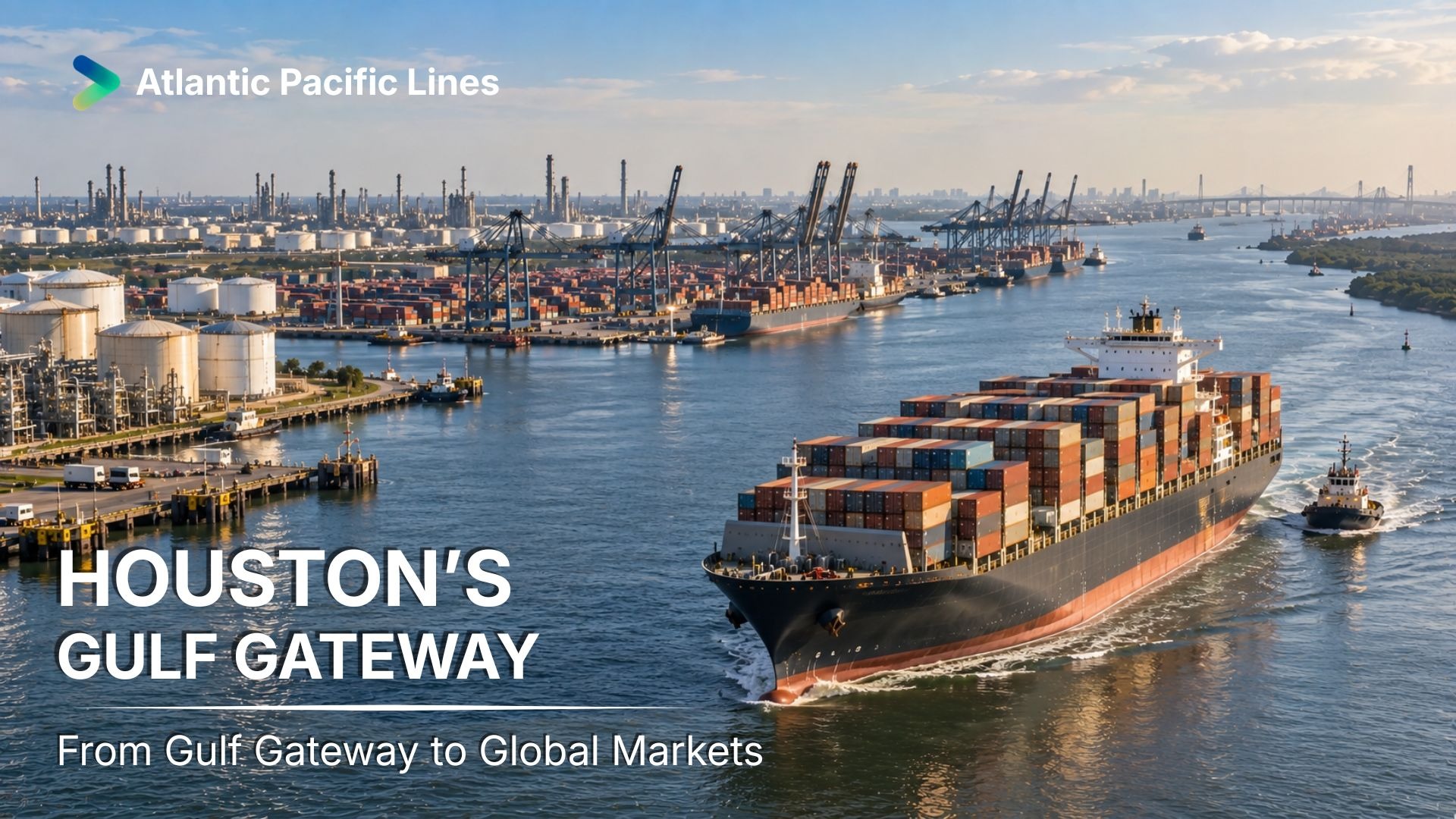
The Port of Houston is the largest container gateway on the United States Gulf Coast and the nation's leading port by foreign tonnage, operating two container terminals, Barbours Cut and Bayport, along the Houston Ship Channel. It is unusual among US gateways for being an export powerhouse as much as an import one, handling a large majority of the country's resin exports alongside a growing base of Texas-bound retail imports. Atlantic Pacific Lines, an FMC-licensed NVOCC, commits to guaranteed vessel space allocation into and out of Houston, with drayage and transload behind it.
The Port of Houston occupies a distinctive place among American gateways. It is the largest container port on the Gulf Coast, the leading United States port by foreign waterborne tonnage, and, unlike the transpacific-driven West Coast ports, it runs on a two-way trade in which exports matter as much as imports. For importers, it is the gateway to the vast Texas consumer market and the south-central United States; for exporters, above all in plastics and chemicals, it is the primary door to world markets. This guide explains what the Port of Houston is, the terminals and the ship channel that define it, the resin and petrochemical export trade that makes it unique, the Texas import market on the other side of the ledger, the landside realities that govern a container's real transit, and how committed vessel space holds a Houston program in both directions.
What the Port of Houston is
Port Houston, operated by the Port of Houston Authority, is a complex of facilities strung along the Houston Ship Channel that connects the city to the Gulf of Mexico. It is the largest container port on the Gulf Coast and has long been the leading United States port by foreign waterborne tonnage, reflecting the enormous energy and petrochemical trade of the region; its container business has grown quickly, passing four million containers a year and setting records in recent years. In national container rankings, it sits among the top handful of United States gateways, behind the two coasts' largest ports but leading the Gulf by a wide margin.
What makes Houston distinctive is the balance of its trade. Most major United States container gateways are dominated by imports, with exports a lighter backhaul. Houston is different because the Gulf Coast is the center of American petrochemical production, and the port moves a very large share of the country's resin and plastics exports out to the world. That two-way balance shapes everything about how the port behaves, from equipment availability to the seasonal rhythm of its trade, and it is the first thing an importer or exporter new to Houston needs to understand.
The terminals and the ship channel
Houston's container trade runs on two purpose-built terminals, both owned and operated by the port, along with the ship channel that serves them and the wider industrial complex.
| Terminal | Role | Notes |
|---|---|---|
| Barbours Cut Container Terminal | The port's original and largest container terminal | Opened in 1977 as the first container terminal in Texas, now undergoing a major multi-year modernization of berths, yard, and cranes |
| Bayport Container Terminal | The port's modern container terminal | The most modern container facility on the Gulf, with a large container yard and an on-site intermodal rail component, the default for the largest vessels |
| Houston Ship Channel | The waterway serving the whole complex | Being widened and deepened so larger vessels can call and pass, easing the one-way traffic limits that constrain the biggest ships today |
Barbours Cut is the older and larger of the two, the first container terminal in Texas, now in the middle of a major multi-year modernization of its berths, yard, and crane fleet. Bayport is the modern facility, with a large container yard, an on-site intermodal component, and the newer equipment that makes it the default for the largest vessels calling the port. The constraint that shapes both is the Houston Ship Channel itself: it is being widened and deepened so that larger vessels can call and pass each other, easing the one-way traffic restrictions that currently limit the biggest ships, but until that work is complete, the channel keeps a ceiling on vessel size that the coastal ports do not face. For a shipper, the practical effect is that Houston is served by a large number of mid-size vessel calls rather than a few of the very largest ships, which actually gives the lane useful frequency.
The export engine: resins, plastics, and petrochemicals
No account of the Port of Houston is complete without its export trade, because it is what makes the port unique and it shapes capacity for importers too. The Gulf Coast petrochemical corridor is the largest in the world, and a very large majority of United States resin and plastics exports, the pelletized raw material for finished plastic goods, moves out through Houston, with much of the country's petrochemical production capacity sitting within a short radius of the port. That export volume is growing as new packaging and production capacity comes online, and it fills a large share of the outbound containers leaving the port.
For an exporter of resins or chemicals, Houston is not one option among several but the natural gateway, and the capacity conversation is about securing outbound space and the right equipment through the growth. For an importer, the strong export trade is relevant in a different way: it changes the equipment balance, because a port that exports heavily has a different empty-container and repositioning pattern than an import-dominated gateway, which can work in an importer's favor for equipment availability. Resin and chemical exporters in particular benefit from committed space and planned equipment, given weight, handling, and volume discipline, an application of the same allocation logic that governs guaranteed space on the export lanes from the United States.
The import side: the Texas and south-central market
On the import side, Houston is the gateway to one of the fastest-growing consumer markets in the country. Texas has grown rapidly in population and industry, and the port serves the Houston metro, the Texas Triangle of Houston, Dallas, San Antonio, and Austin, and the wider south-central United States, with retail and consumer imports, furniture, and refrigerated goods among the growing inbound categories. For cargo bound for this region, landing at Houston avoids the long inland haul that a West Coast or East Coast arrival would require, placing goods close to a large and expanding market.
Houston also handles the range of cargo a full-scale port supports beyond standard containers, including the breakbulk and project cargo tied to the region's energy and construction industries, and it sits near roll-on/roll-off automotive capacity in the wider area. For a containerized importer, the key point is that Houston has become a genuine alternative to the coastal gateways for Texas and south-central distribution, with the frequency and capacity to support a real import program, not just an occasional call.
Why Houston's import volume keeps growing
Houston's container imports have grown faster than almost any other gateway's in recent years, and the reasons are structural rather than temporary. Texas has been among the fastest-growing states in both population and industry, which steadily raises the consumer and manufacturing demand the port serves. At the same time, importers diversifying their supply chains and their gateways, spreading risk away from a single coast or a single port, have added Houston as a genuine option for cargo that once defaulted to the West Coast, and the port's investment in terminals, equipment, and channel capacity has made it able to absorb that growth.
For a shipper, the practical implication is the same one that applies at every growing gateway: opportunity paired with the need to plan. A port adding capacity is betting on continued demand, which is good for a shipper building a long-term program there, but a growing port is also a busier one where peak-period space and landside capacity must be secured rather than assumed. Houston's two-way trade sharpens this further, because the growth on the import side meets the established strength on the export side, and both draw on the same vessels, equipment, and gates. Planning a Houston program with that growth in view, rather than treating current capacity as permanent, is what keeps a shipper ahead of the gateway's trajectory.
Foreign trade zones and the energy-project dimension
Two further features shape how cargo moves through Houston, both tied to the region's industrial character. The first is the density of foreign trade zones and bonded facilities around the port, which let importers defer or manage duties on goods held near the port before they formally enter United States commerce. For businesses holding inventory, staging distribution, or managing duty on high-value or high-volume goods, locating that activity in a foreign trade zone near the gateway can be a meaningful cost and cash-flow tool, and the Houston region offers an extensive network of such facilities tied to its manufacturing base.
The second is the project and industrial cargo that the region's energy economy generates. Beyond standard containers, Houston handles substantial breakbulk and project cargo, the oversized and heavy-lift equipment that feeds construction, energy, and industrial projects across the Gulf Coast and beyond. While that cargo often moves outside the container terminals, its presence shapes the port's character and its landside network, and importers of machinery, equipment, and industrial goods benefit from a gateway that understands cargo more complex than a standard box. For a containerized shipper, the relevant point is that Houston is a full-service industrial gateway, not only a container port, which brings depth of handling capability that suits the region's cargo.
Seasonality and the two-way rhythm
Houston's trade has a rhythm shaped by its two-way character, and understanding it helps a shipper plan. On the import side, the port follows the broader retail and consumer pattern, building toward the seasons that drive Texas and south-central consumption, so inbound space and landside capacity tighten in the same general periods as other import gateways. On the export side, the resin and petrochemical trade follows the production and contract cycles of the Gulf Coast petrochemical industry, which do not always align with the import peaks, so the outbound demand for space and equipment has its own timing.
The interaction of the two is what makes Houston distinctive to plan for. When import and export demand both run strong, the competition for vessel space, equipment, and gate capacity intensifies from both directions at once, and a shipper focused on only one side can be caught by pressure originating on the other. An importer can find equipment tight because exporters are drawing on the same containers, and an exporter can find space tight because import demand is filling the vessels. Planning a Houston program means watching both sides of the trade, not just the direction the cargo happens to travel, which is a discipline unique among the major United States gateways to a port this balanced between imports and exports.
The landside realities that govern a container's transit
As at any gateway, the landside decides how smoothly a container actually moves. Terminals run on appointment and gate systems, chassis are supplied through pools that can tighten in busy periods, a container has limited free time before demurrage begins, and customs, freight, and terminal holds must all be cleared before release. The charges that catch shippers out, demurrage and detention, accrue in the gaps when any of these misalign, and building each move backward from the terminal cutoffs and the free-time clock is as important here as the ocean booking. Houston's newer equipment at Bayport and its generally strong chassis position help, but the discipline is the same: plan the landside against the actual vessel.
Houston's two-way trade adds a wrinkle worth planning for, which is the empty container. On a port that exports as heavily as Houston, the movement and availability of empty containers for export loading, and the return of import empties, is a live operational factor that a purely import-focused shipper may not expect. An exporter needs an empty in the right place at the right time to load, and an importer needs to return one, and both compete for the same equipment and gate capacity. Coordinating the empty side is part of moving cleanly through this gateway in a way that matters more here than at an import-only port.
What a move through Houston actually costs
Budgeting for Houston means counting the full landside stack in whichever direction the cargo moves. On the import side, that is the drayage, the chassis days, any terminal fees, the inland leg into the Texas market, and the demurrage and detention that accrue when timing slips. On the export side, it is the drayage bringing loaded containers to the terminal, the equipment to load into, and the cost of missing a vessel cutoff, which for a resin or chemical exporter can mean holding heavy cargo and rebooking. A clean move in either direction carries only the predictable items, while a stalled one accumulates charges fast, so the drayage quality and the clearance or cutoff discipline feed straight into the delivered cost.
The way to protect the budget is to design out the avoidable charges. On imports, clearing customs before arrival, securing appointments, and watching the free-time clock prevent demurrage and detention. On exports, building the move backward from the vessel cutoff and coordinating the empty container prevent missed sailings. Because these avoidable costs can exceed the base rate, the shipper who plans them out at Houston, on the side of the trade that matters, protects more of the landed or delivered cost than the freight rate alone ever touches, and does so at a gateway where the two-way trade makes both equipment and timing more contested than at an import-only port.
Drayage, transload, and holding the space
Moving the container between the terminal and its destination is drayage, and at Houston it means coordinating the terminal release, the appointment, the chassis, the hold status, and, given the export trade, the empty-container picture. For imports bound into the Texas market, that is often a short move to a regional distribution center; for exports, it is the reverse flow of bringing loaded containers to the terminal against the vessel cutoff. Book Your Cargo, the drayage arm of Atlantic Pacific Lines, provides the drayage and coordination that keep both directions moving, and transload and warehousing near the port supports importers distributing across Texas and exporters staging cargo for loading.
Underneath the drayage sits the vessel space, and in both directions it is what protects the schedule. Import cargo into Houston competes for space on the same lanes that feed it, and resin and chemical exports compete for outbound slots and equipment through a growing export trade. Atlantic Pacific Lines books against direct service contracts with major ocean carriers and commits space into and out of Houston, with the equipment planned into the commitment, so cargo holds its sailings in both directions. On full container load programs, that two-directional commitment is what lets a Houston program, whether import distribution or resin export, run on the calendar it was planned on.
Houston versus the coastal gateways for Texas cargo
For cargo bound for Texas and the south-central United States, the real choice is often between Houston and a coastal gateway with an inland move, and the comparison turns on delivered cost and time rather than ocean transit alone. Landing at Houston places the cargo in the middle of the Texas market directly, with no long transcontinental leg, which for goods consumed in the region is usually decisive. Routing instead through a West Coast port and rail to Texas, or through an East Coast port and moving inland, adds the length and cost of that inland leg, which for a Texas destination rarely beats a direct Houston call once the full delivered picture is counted.
The considerations that can point the other way are vessel size and frequency: the coastal ports handle the very largest ships and, on some lanes, offer more frequent or faster direct services, so a shipper weighing pure ocean speed on a specific lane should compare the actual services. But for the core question of serving the Texas and south-central market efficiently, Houston's direct access to the region is the advantage that the channel and terminal investments are steadily reinforcing. As with every gateway decision in this cluster, the right answer follows the freight's destination and total delivered cost, not the headline ocean transit, and for a great deal of Texas-bound cargo that answer is Houston.
How to ship smoothly through the Port of Houston
A short set of habits keeps cargo moving through the largest Gulf gateway in both directions.
- Secure committed vessel space for the direction that matters: outbound slots and equipment for resin and chemical exports, inbound space for Texas-bound imports, ahead of the peak.
- Plan the empty container, since a heavily exporting port makes empty availability and repositioning a live factor for both loading exports and returning import boxes.
- Match weight and equipment discipline to the cargo, especially for dense resin and chemical exports that run close to the limits.
- Plan drayage and appointments against the actual vessel, and use the Texas warehouse market near the port for import distribution and export staging.
- Watch the free-time clock and clear customs and holds early, so an import container releases promptly and an export container makes its cutoff.
- Plan around the ship channel reality, expecting frequent mid-size vessel calls rather than the very largest ships until the channel work is complete.
Shippers who plan the gateway this way make the largest Gulf port a reliable step in both directions. It is the basis on which Atlantic Pacific Lines commits space into and out of the Port of Houston and coordinates the drayage and transload behind it, so cargo moves from vessel to final door, or from factory to vessel, as one plan.